
Legacies and Lessons from the Upper Clyde Shipbuilders Work-In of 1971/72
Home > Legacies and Lessons from the Upper Clyde Shipbuilders Work-In of 1971/72
This blog post by Mike Power (Oxford Brookes University) reflects research supported by the Economic History Society’s Research Fund for Graduate Students. The research will form part of their PhD thesis, “Rethinking the Upper Clyde Shipbuilders Work-In of 1971-72 – Significance, Impact and Legacy”.
—
‘We are not wildcats. We want to work. The real wildcats are in Number 10 Downing Street. We don’t only build ships on the Clyde, we build men. They have taken on the wrong people and we will fight.’
–Jimmy Reid, UCS Shop Steward, July 1971
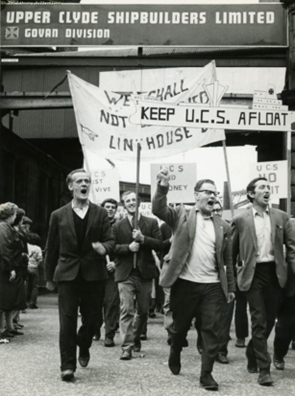
Image courtesy of Special Collections (TUC) at London Metropolitan University.
The once vast UK shipbuilding industry had been in structural decline since the 1960s and received various forms of government support from that time on. In June 1971 the Conservative government under Edward Heath announced the end of financial support for Upper Clyde Shipbuilders (UCS).
UCS was a consortium of surviving Glasgow shipyards that the previous Labour government had merged to improve productivity and competitiveness against increasing foreign competition. The Heath Government’s decision was based on their policy of no further taxpayer support for ‘lame duck’ industries.
The UCS shop stewards represented 8,000 workers whose livelihoods were immediately threatened, and indirectly at least as many again from local businesses supporting the shipyards. In an area already suffering above average unemployment the threatened closure was a devastating prospect.
1971/72 was a tumultuous period of industrial confrontation in the UK as the government’s new Industrial Relations Act began to force greater trade union regulation. This legislation was resisted by the unions with strikes and workplace occupations, notably the first miners’ strike of 1972 which ran concurrently with the later stages of the UCS dispute.
But the UCS shop stewards eschewed a strike and devised a unique response by refusing to stop working and launching a ‘work-in’, taking physical control of the yards and continuing to build the ships that the company was still contracted to complete. This approach of continuing to work reflected the moral as well as the political dimensions of their difficulty.
Their framing of the campaign as the ‘Right to Work’ was timely, well received and deflected criticism, common at the time, of the workforce being work shy or politically motivated. This approach had important consequences in rapidly gaining support from other unions, local communities and businesses as well as prominent Labour politicians including Tony Benn.
In August 1971 Glasgow’s biggest demonstration since the war took place as over 40,000 supporters marched through the city centre to a benefit concert at Glasgow Green. These two events generated significant media interest and within weeks the work-in had become a national cause célèbre, fuelled by sustained news coverage of the dispute.
Boy Scouts and pensioners sent postal orders in support and John Lennon and Yoko Ono sent a £1,000 cheque and a bouquet of red roses with the note ‘Power to the people’. By February 1972 the government capitulated and agreed to reinvest in the former UCS yards with all the former UCS workforce being reinstated into the successor companies.
This was seen as a significant victory for the shipyard communities and organised labour, for the government it resulted in a policy U-turn to help curb unemployment. My research investigates this unique dispute by exploring the legacies and lessons of the work-in for us now and the generous grant from the Economic History Society will assist in archival research at the University of Glasgow.
In his 1985 introduction to The Politics of the UCS Work-In (John Foster and Charles Woolfson) Tony Benn makes important observations on the deeper significance of the work-in for Scotland. This includes how the work-in pioneered the idea of workers developing an alternative plan of their own and how this plan was quickly adopted by local communities.
Benn also identified how the national identity of Scotland was threatened by the government’s action and how ‘the working class may mobilise popular feeling around a sense of national identity … and do so without the narrow nationalism that always characterises right-wing leadership’.
The Scottish Trade Union Council had given significant early assistance to the work-in and sensing the increasing importance of this to the question of Scotland’s post-industrial future pressed for a convention to discuss unemployment as a national issue. This became the first Scottish Assembly, held in Edinburgh in February 1972 and attended by most of Scotland’s local government, institutions and business representatives.
Hamish Grant, secretary of the CBI (Scotland), commented to the Glasgow Herald, ‘The intensity of feeling for further devolution came through in a way which I have never heard before. It was obvious that there is a call for greater devolution and responsibility through the institutions of Scotland’.
These comments show some of the deep roots of devolution in the 1970s that would develop later and result in today’s Scottish Parliament. The Collection of Hay and Woolson at the University of Glasgow’s archives offers possible insights into this process from interviews made in the 1970s with a variety of people associated with the work-in.
Some of these recordings remain in their original tape format, neither digitized nor transcribed. In examining these recordings, I hope to help in their digitisation and find evidence of how a local dispute grew into a national issue, changed a government’s course and possibly provided the ‘vital spark’ to a reassessment of Scottish identity.
To contact the author:
Mike Power
Email: 19042412@brookes.ac.uk
Oxford Brookes University
