Power and Plenty? A New, Quantitative Lens on the British Empire
Home > Power and Plenty? A New, Quantitative Lens on the British Empire
In this blog post Noam Yuchtman (London School of Economics) and Karolina Hutkova (London School of Economics) present their research, which was supported by the EHS through the Carnevali Small Research Grants Scheme.
—
Eighteenth century Britain provides the canonical political economy case of economic growth and state development arising from the establishment of “inclusive” political institutions (i.e., parliamentary supremacy; see North and Weingast, 1989; Acemoglu and Robinson, 2012). Yet, the historical literature offers a very different interpretation, shifting attention to the combination of expanded government power and international trade (Williams 1944; Beckert 2014; Berg and Hudson, 2023). Scholars making this argument view military power as central to the historical expansion of trade, which, in turn, generated government revenues, which further supported military power (O’Brien, 1988). Findlay and O’Rourke (2009) propose that this created a virtuous cycle of “Power and Plenty.” Up to now, this theory has not been quantitatively evaluated due to the enormous challenge of collecting the necessary archival data on Britain’s trade, tax revenue, and military conflict.
My collaborators (Prof. Ernesto Dal Bó, UC-Berkeley; Dr. Karolina Hutková, LSE; and Dr. Lukas Leucht, University of Oxford) and I are now at work addressing this challenge. Aided by technological advances in machine learning, we have made significant progress toward the construction of new historical datasets on Britain’s trade, tax revenue, and military conflict, from the 17th-19th century. These data will allow us to quantitatively describe the development of Britain’s state and imperial economy with new granularity and allow us to test the causal mechanisms proposed by the “Power and Plenty” hypothesis.
We have already completed some of this task, having constructed novel datasets on Excise tax revenues collected from overseas traded goods, as well as on tax rates on traded goods (discussed in Dal Bó et al., 2025). These data have already revealed important new insights: in particular, while previous scholarship emphasized the importance of domestic indirect tax revenue for the growth of the British state (Brewer, 1989), our far more granular data revealed that indirect taxation on overseas trade was actually more important (see Figure 1). This work thus brings the Empire back into the story of British fiscal development and suggests support for one link in the Power and Plenty cycle: overseas trade contributed substantially to the state’s fiscal revenues. We have also collected complete data on military conflicts involving Britain between 1400 and 1850, using the Dictionary of Battles and Sieges (Jacques, 2007).
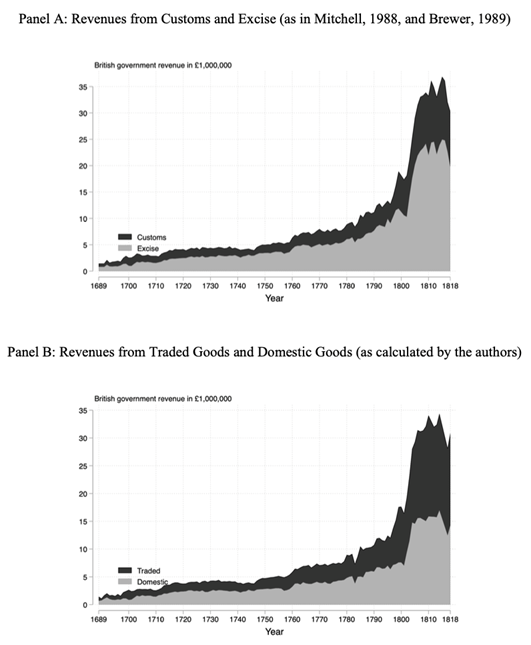
Source: Dal Bó et al. (2025).
The key remaining task is the collection of historical trade data. Aggregate British trade data were previously collected by Schumpeter (1960) and Davis (1979). The existing state-of-the-art dataset on disaggregated British trade in the 17th-19th centuries was painstakingly collected by David Jacks, Kevin O’Rourke, Alan Taylor, and Yoto Yotov (see Jacks et al., 2020, updated in 2025, for a discussion). They summarize the challenge of collecting these data as follows (p. 2), “The primary sources of the data are the export ledgers compiled by the Customs and Excise Department under various titles from 1697 to 1899 … These were entirely hand-written until the mid-19th century, and remained partly hand-written thereafter, thus precluding the use of optical character recognition software.” The limitations of human data collection from such sources restrict the authors’ data to 21 years observed over their 200-year time period; to exports only; and to the study of aggregations of product categories.
However, since Jacks, O’Rourke, Taylor, and Yotov’s data collection, machine learning advances have made it possible to use computer vision for a substantial component of the collection of handwritten historical data. My coauthors and I have partnered with an AI firm to digitize all 35,000 pages of the CUST 3 trade data – covering the years 1697-1780 – in the British Archives, with extremely low error rates, and with flags generated to help identify errors for human correction. These data include every year, product, and both exports and imports.
Generous funding from the EHS is supporting the final steps toward constructing a panel dataset on trade volumes and values by product, year, and place of origin/destination for the years 1697-1780. These steps are, first, human correction of remaining transcription errors; second, the conversion of accurately transcribed data into a cleaned, standardized, and historically valid dataset. One component of this standardization is completed: extracting port names from the CUST 3 ledgers. This allows us to document changes in the geography of Britain’s trade over time, providing initial evidence on the link between military conflict and trade. Extracting ports from the CUST 3 ledgers, we can document changes in North American and Caribbean trading ports following Britain’s victory over France in the “French and Indian War” (1754-1763). In Figure 2, below, we show an expansion in the number of ports in North America and the Caribbean following the war. Once the trade data are cleaned, we can more finely measure changes in trade leading up to, and following, military conflict.
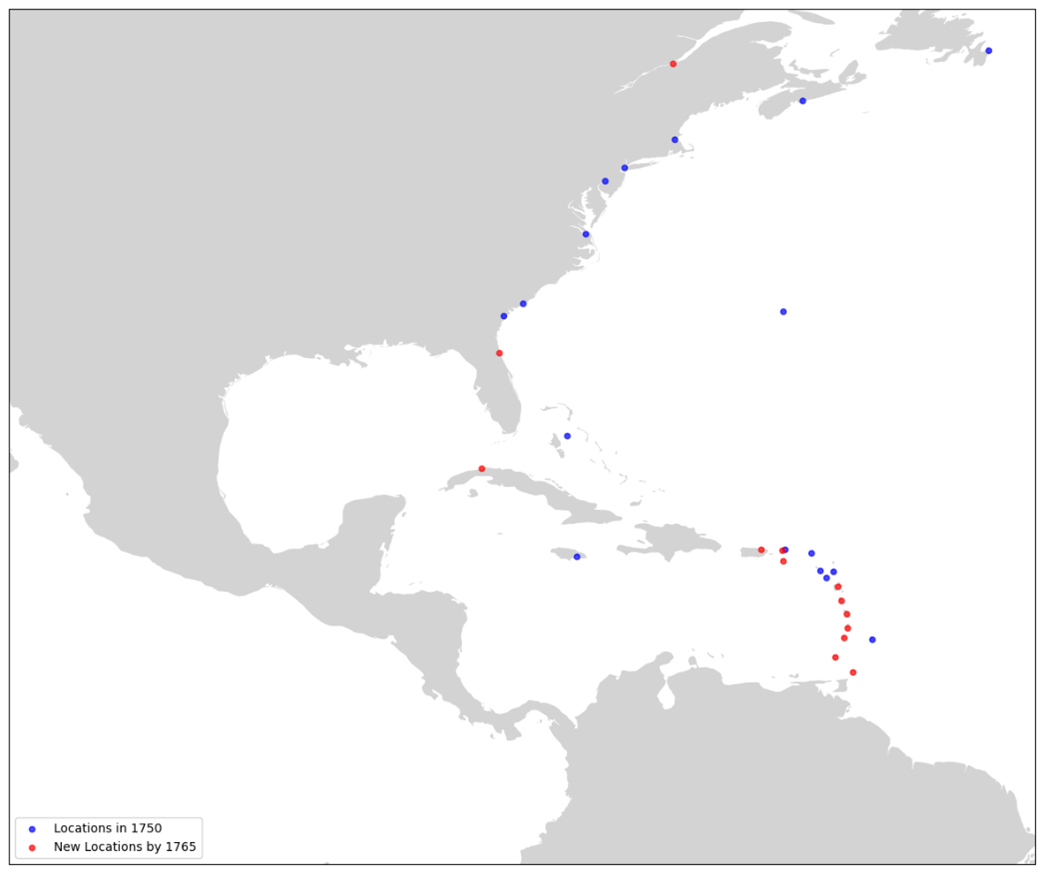
Source: Authors’ analysis of the CUST 3 ledgers.
A final step requires a great deal of historical expertise: standardizing and harmonizing nearly 1 million historical product names, many of which are obscure, some of which vary over time, while others are misspelled. We are now at work matching a glossary of historical product names (taken from a range of historical sources, such as books of customs rates, and sources on the trade of the East India Company) to the raw CUST 3 product names. A screenshot indicating our work in progress (as we develop and improve our matching model) is presented in Figure 3, below. The figure provides an indication of the obscurity of the historical goods and the challenge of successful matching – as well as the promise of success, even using a very early iteration of our model.
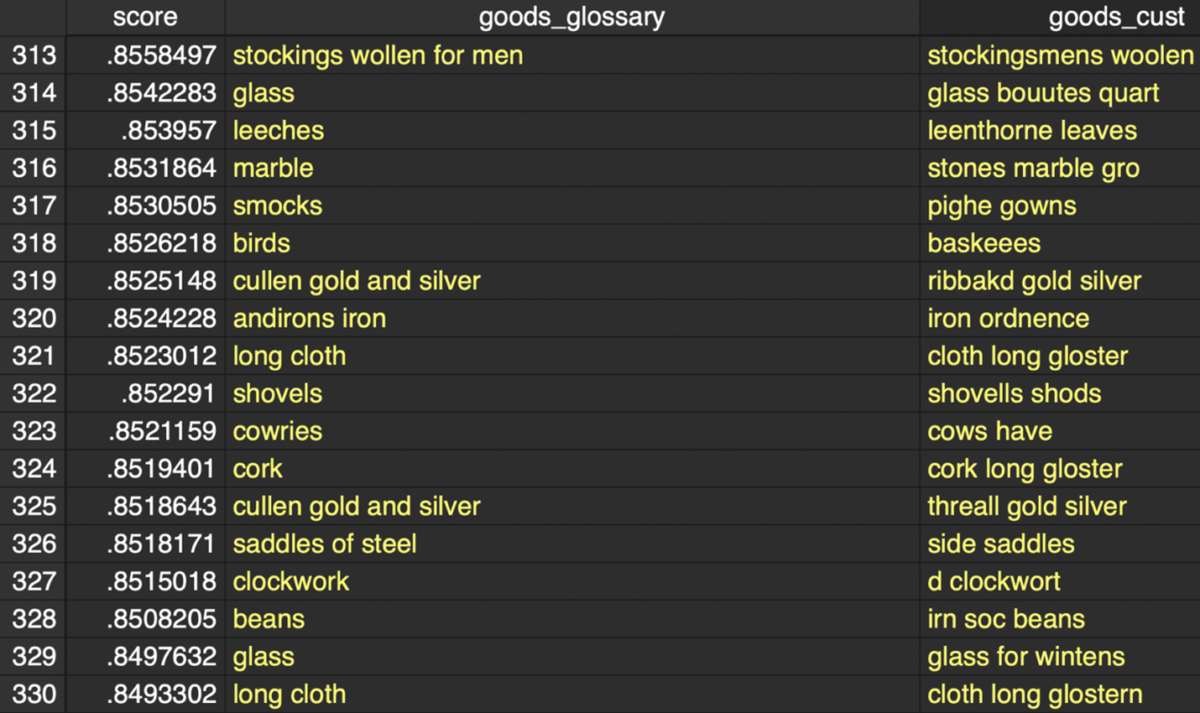
Source: Authors’ (preliminary) analysis of the CUST 3 ledgers.
Once this process of matching and cleaning products is complete, we will conduct our comprehensive empirical analysis of the Power and Plenty hypothesis and post the resulting panel dataset online. We hope that these highly disaggregated data – yearly volumes and values of imports and exports, by product and place of origin/destination – will be of value to political economists, economic historians, and trade economists; to historians specializing in Britain and its Empire, as well as to cultural and material historians; and, to the general public.
References:
Acemoglu, Daron and James A. Robinson. Why Nations Fail: The Origins of Power, Prosperity and Poverty. London: Profile, 2012.
Beckert, Sven. Empire of cotton: A Global History. Vintage, 2015.
Berg, Maxine, and Pat Hudson. Slavery, Capitalism and the Industrial Revolution. John Wiley & Sons, 2023.
Brewer, John. The Sinews of Power: War, Money, and the English State, 1688-1783. London: Unwin Hyman, 1989.
Dal Bó, Ernesto, Karolina Hutková, Lukas Leucht, and Noam Yuchtman. “Dissecting the Sinews of Power: International Trade and the Rise of Britain’s Fiscal-Military State, 1689-1823.” The Journal of Economic History (2025): 1-34.
Davis, Ralph. (1979), The Industrial Revolution and British Overseas Trade. Leicester: Leicester University Press.
Findlay, Ronald, and Kevin H O’Rourke. Power and Plenty: Trade, War, and the World Economy in the Second Millennium. Princeton, NJ: Princeton University Press, 2009.
Jacks, David S., Kevin Hjortshøj O’Rourke, Alan M. Taylor, and Yoto Yotov. “Distance, Empire, and British Exports Over Two Centuries.” NBER Working Paper no. 27904 (2020, revised 2025).
Jaques, Tony. Dictionary of Battles and Sieges: A Guide to 8,500 Battles from Antiquity through the Twenty-first Century, Volumes 1-3. Westport,CT: Greenwood Press, 2007.
Mitchell, Brian R. British historical statistics. Cambridge University Press, 1988.
North, Douglass C., and Barry R. Weingast. “Constitutions and Commitment: The Evolution of Institutions Governing Public Choice in Seventeenth-century England.” The Journal of Economic History 49, no. 4 (1989): 803-832.
O’Brien, Patrick K. “The Political Economy of British Taxation, 1660-1815.” Economic History Review (1988): 1-32.
Schumpeter, Elizabeth B. (1960), English Overseas Trade Statistics, 1697–1808. Oxford: Clarendon Press.
Williams, Eric Eustace. Capitalism & Slavery. Chapel Hill: Univ. of North Carolina Press, 1944.
To contact the authors:
Noam Yuchtman
noam.yuchtman@gmail.com
London School of Economics
Karolina Hutkova
K.Hutkova@lse.ac.uk
London School of Economics
