The Political Economy and Effectiveness of Early Twentieth Century British Alcohol Policy
Home > The Political Economy and Effectiveness of Early Twentieth Century British Alcohol Policy
Padraig McKee (Queen’s University Belfast) is a recipient of a grant from the Economic History Society’s Research Fund for Graduate Students. In this blog, he provides an overview of the research which this grant has enabled.
—
As Britain entered the 20th century, the debate over alcohol regulation reached a level of intensity rarely seen before or since. As a result, several innovative policies were introduced which attempted to sufficiently regulate alcohol whilst not excessively restricting personal liberty. These included prohibition via local option polls, the nationalisation of the alcohol trade to establish a government monopoly, and increased licensing powers for local magistrates (Nicholls 2009, pp. 229—230). My PhD focuses on two of these policies: the government-owned alcohol monopoly known as the State Management Scheme, and the system of local option polls. In this blog, I introduce the work on local option polls funded by the Society’s grant.
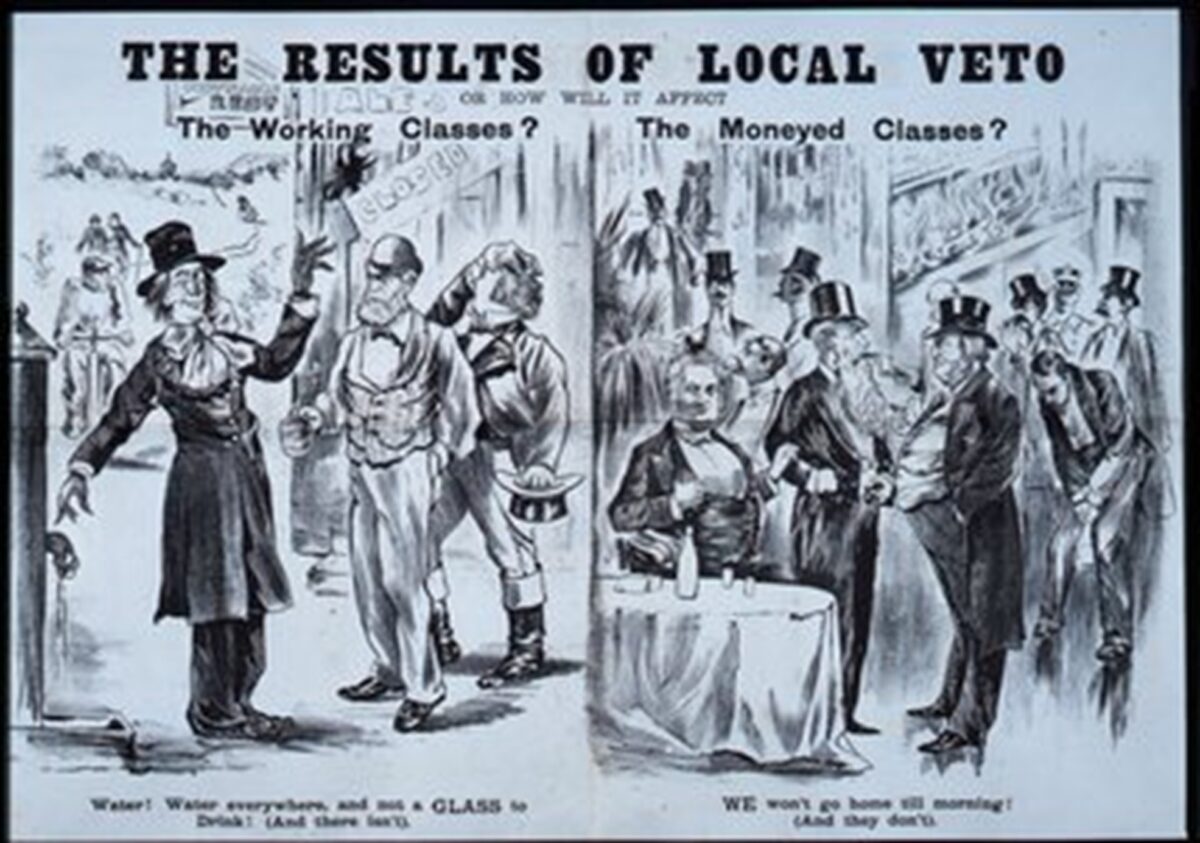
Local option polls were the central demand of those in the temperance movement who wanted prohibition. The polls allowed local communities to hold binding votes on alcohol regulation in their area. Voters had three options: no change, a reduction in the number of licences, and the removal of all licences (that is, local prohibition). Earlier versions of the policy, known as the local veto, only included the binary choice between no change and no licences.
Local option polls came into law in Scotland with the Temperance (Scotland) Act 1913. The policy had been supported by the Liberal government since their election victory in 1892, but sufficient support was not available to pass the bill through Parliament. Those who opposed the bill being introduced for all of Britain were more acquiescent to its introduction in Scotland, where Liberal MPs overwhelmingly supported it (Greenaway 2003, pp.73—85). Polls were held at the parish-level, town-level and ward-level for towns and cities with a population exceeding 25,000. The first polls were held in 1920. By 1930, over 1000 local polls had been conducted. Although there has been significant research on the temperance movement in Britain (Harrison 1971; Greenaway 2003; Nicholls 2009), little research has examined the local option.
These local option polls are important for two reasons. Firstly, they provide a record of how ordinary people felt about alcohol control at a specific time and place. By collecting the results of these polls and marrying them with socioeconomic variables, it is possible to examine the determinants of support for prohibitive alcohol policies. Specifically, this will deepen our understanding of the temperance movement in Scotland whilst also adding to the wider literature on determinants of support for prohibitions in other settings, including the U.S.A. (Endersby 2012; Lewis 2008); Canada (Dostie & Dupré 2012); New Zealand (Dostie & Dupré 2016). More broadly, it helps us understand the political economy of state interventions into our way of life.
Secondly, as some licensing districts voted for prohibition, these polls provide an ideal natural experiment to measure the effects of prohibition on a range of outcomes. Of the polls held in 1920, 14 towns and 12 wards of larger towns voted for no licences. A further 8 towns and 19 wards voted for a 25% reduction in licences. By comparing the areas that marginally voted for prohibition with those that marginally did not, we can compare outcomes between otherwise similar areas. How do local prohibitions affect crime, health and mortality? By contributing to the growing literature on alcohol availability and crime, health and mortality, this research can provide useful parallels to contemporary debates on the regulation of harmful substances.
Since receiving this grant, I have been able to undertake the archival visits necessary to build a clearer picture of the history of the local option polls in Scotland and collect the data required to answer the questions posed above. At this stage in my research, I cannot provide answers to any of these questions. In the future, I hope to do so in a second blog.
Bibliography:
Butler, K. Drink Maps in Victorian Britain (Oxford, 2024).
Dostie, B. and Dupré, R. ‘Serial Referendums on Alcohol Prohibition’, Social Science History 40, 3 (2016): pp. 491-521.
Dostie, B. and Dupré, R. ‘‘The people’s will’: Canadians and the 1898 referendum on alcohol prohibition.’ Explorations in Economic History 49, 4 (2012): pp.498–515.
Endersby, J. W. ‘Prohibition and repeal: Voting on statewide liquor referenda in Texas.’ The Social Science Journal 49, 4 (2012): pp. 503–12
Greenaway, J. Drink and British Politics since 1830: A Study in Policymaking (Basingstoke, 2003).
Harrison, B. Drink and the Victorians: The Temperance Question in England 1815–1872 (Pittsburgh, 1971).
Lewis, Michael ‘Access to saloons, wet voter turnout and statewide prohibition referenda, 1907– 1919.’ Social Science History 32, 3 (2008): pp. 373–404
Nicholls, J. The Politics of Alcohol: A history of the drink question in England (Manchester, 2009).
To contact the author:
Padraig McKee
Email: pmckee18@qub.ac.uk
LinkedIn: https://www.linkedin.com/in/padraigmckee/
Department of Economics
Queen’s University Belfast
