
Zhangzhou Porcelain: Export Ceramics from Fujian during the Late Sixteenth and Early Seventeenth Centuries
Home > Zhangzhou Porcelain: Export Ceramics from Fujian during the Late Sixteenth and Early Seventeenth Centuries
This blog by Judy Law of the University of Warwick is based upon a grant awarded by the Economic History Society through its Research Fund for Graduate Students.
—
During the sixteenth and early seventeenth centuries, Europeans established long-distance maritime trade routes across the Pacific and Atlantic oceans. These European-Asian interactions spurred the rapid growth of the global market for Chinese goods and facilitated a continuous influx of American and Japanese silver into Ming China. In the first year of the Longqing reign period (1567), the Ming court partially lifted the long-standing maritime ban and permitted private trade at the Yuegang seaport in Zhangzhou. It allowed different sectors in Zhangzhou and the broader Southern Fujian region to benefit from the expanding maritime trade. Against this background, Zhangzhou kilns emerged as key producers of export porcelain, flourishing alongside the famous Jingdezhen kilns in Jiangxi province. By diversifying their products and catering to distinct markets, Zhangzhou kilns secured their place in the global market. While Jingdezhen porcelain was primarily sold to European and Spanish American markets, Zhangzhou concentrated on customers in Southeast Asia and Japan. Existing scholarship has extensively examined the trade of Jingdezhen fine porcelain to Europe and America. However, the trade of Zhangzhou porcelain, which used to be known as ‘Swatow’ porcelain, to Japan and Southeast Asia is waiting to be fully explored.
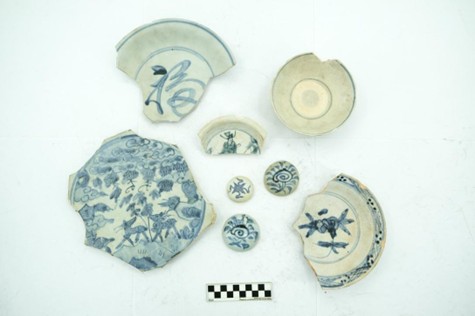
Collection of National Museum of the Philippines. Photograph: author.
Zhangzhou porcelain is generally crudely potted, with thicker bodies, cracked glaze and sandy grits on the bases. As a result, it was labelled by Dutch merchants as grove porselein (literally ‘coarse porcelain’) and targeted specifically for intra-Asian trade according to the Dutch East India Company (Vereenigde Oost-Indische Compagnie, abbreviated as VOC). Nevertheless, it should be noted that the thicker walls and heavier bodies also made the wares more durable for everyday use and they have been passed down through generations in Japan and Southeast Asia. Generally, the existing scholarship on Zhangzhou porcelain pivots on the technical aspects of porcelain-making—manufacturing technique, artistic style, and comparison with Jingdezhen porcelain. But porcelain also serves as an excellent indicator for tracing interactions and connections between various regions and countries due to its durability and resistance to corrosion in soil and underwater environments. My research seeks to provide a more comprehensive understanding of the Chinese porcelain trade during the late sixteenth and early seventeenth centuries by telling the stories of the long-neglected Zhangzhou porcelain. I aim to reveal how Zhangzhou porcelain was produced, traded, and consumed under the intricate influences of craftsmen, merchants, and customers and to gain an understanding of both the historical network of intra-Asian porcelain trade and the exchange of material culture among China, Japan, and Southeast Asia.
Manila ranked among the primary ports in Southeast Asia at that time, serving as an entrepôt for the trans-Pacific Manila Galleon exchange and facilitating Sino-Japanese trade against the Ming’s exclusion of Japanese traders from China’s coast. In addition, goods were also transhipped to other ports in Southeast Asia through intra-Asian maritime networks. Given the Philippines was a primary importer of Zhangzhou porcelain throughout the sixteenth and early seventeenth centuries, and its vital role played in the maritime trade between China, Spain and Japan, abundant Zhangzhou porcelain has been excavated from the terrestrial and underwater archaeological sites across the Philippines, as well as along the maritime route connecting Yuegang and Manila.
With the support of the Research Fund for Graduate Students, I travelled to Manila between July and August 2024. During my visit, I primarily focused on researching the underwater archaeological collections at the National Museum of the Philippines, as well as meeting with scholars at the Asian Centre and the Department of Archaeology at the University of the Philippines, Diliman. In the Philippines, various types of shipwrecks carrying Zhangzhou porcelain have been discovered. These include Manila Galleons like Nuestra Señora de la Vida and San Diego, as well as non-galleon shipwrecks such as San Isidro, Royal Captain Junk and Marinduque. The latter were Chinese junks or local boats to transport trading commodities from larger vessels to land-based merchants within the interisland maritime trade network. Their wide geographical distribution of shipwrecks not only highlights the vital role of non-European agents in regional trade but also demonstrates the equally vibrant commercial activities beyond the galleon navigation route, as Bobby C. Orillaneda has noted. Moreover, the recovery of fragmented porcelain pieces from the non-galleon shipwrecks consists mostly of Zhangzhou wares. They were of inferior quality compared to their Jingdezhen contemporaries found on the Manila Galleons. This suggests that Zhangzhou porcelain was intended for less selective customers and possibly for everyday use by the general population in the Philippines. Porcelain is not only a useful tool for dating shipwrecks, but when combined with textual materials, it also provides a more concrete understanding of the production and circulation of Chinese ceramics in Southeast Asia during the sixteenth and seventeenth centuries.
References:
Orillaneda, Bobby C., ‘Maritime Trade in the Philippines during the Early Colonial Period (Sixteenth and Seventeenth Centuries CE)’, in Historical Archaeology of Early Modern Colonialism in Asia-Pacific: The Asia-Pacific Region, ed. by Maria Cruz Berrocal and Cheng-hwa Tsang (Gainesville: University Press of Florida, 2017), pp. 29–59.
Tan, Rita C., Zhangzhou Ware Found in the Philippines: ‘Swatow’ Export Ceramics from Fujian 16th-17th Century (Manila: Yuchengco Museum, 2007).
To contact the author:
Judy Law
University of Warwick
