
RHS/EHS Lecture: The Charitable Corporation Scandal of 1732 with Amy Froide

Date / time
04/12/2026, 4:00 pm - 5:30 pm
04/12/2026, 4:00 pm - 5:30 pm
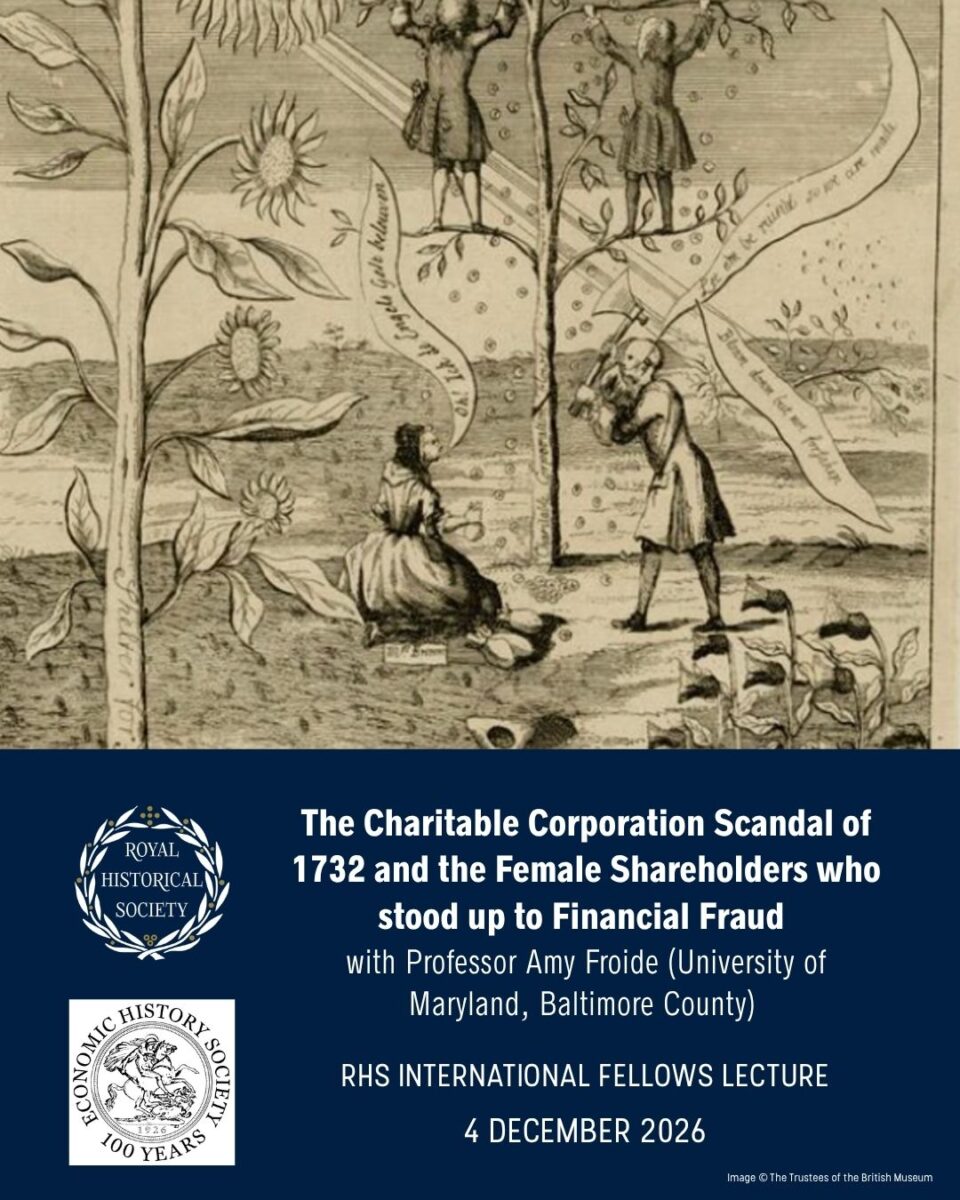
This lecture will explore the activist female shareholders of one eighteenth-century company, the Charitable Corporation, to illuminate women’s role in Britain’s financial history. Established in 1707 to make low-interest loans to the ‘industrious poor’, the Charitable Corporation was exceptional in its inclusion of women as charter members. The significance of women to the corporation continued as they represented over one third of company investors by 1731. Not merely passive investors, women who held shares in the company exhibited a notable sense of proprietorship in the venture. When a financial scandal rocked the Corporation in 1732, and both Directors and officers were caught embezzling funds, the shareholders protested. A group of them petitioned Parliament to punish the swindlers, with one third of the signatories being women. The Parliamentary investigation of the Charitable Corporation’s fraud was singular enough that the MPs made an exception and allowed women to view the House proceedings because of their notable financial losses. From inception to demise, the female investors in the Charitable Corporation stand out for their active involvement in shareholding and their demand for a Parliamentary ‘bail out’. These women claimed a public, political voice based on their financial contributions.
Amy Froide is Professor of History and Director of the Dresher Center for the Humanities at the University of Maryland, Baltimore County. She is a historian of women and the economy of early modern Britain. Her publications include Silent Partners: Women as Public Investors during Britain’s Financial Revolution, 1690-1750 (Oxford University Press, 2016) and Never Married: Singlewomen in Early Modern England (Oxford University Press, 2005). She is currently working on a book on the Charitable Corporation and a project on separated wives in early modern England. Her research has been supported by fellowships from the British Academy, the Folger Shakespeare Library, the Huntington Library, and the Rockefeller foundation/Newberry Library. She is the Presidential Teaching Professor at UMBC for 2024-27. She has been a book review editor for the Journal of the British Studies and is the incoming President of the Society for the Study of Early Modern Women.
This lecture is hosted in partnership by the Royal Historical Society and the Economic History Society.
