
Land Privatisation and the Exodus from 19th-Century Galicia
Home > Land Privatisation and the Exodus from 19th-Century Galicia
In this blog post Angel Muniz-Mejuto (Universidad Carlos III de Madrid) presents their research, some of which was presented at the recent EHS Conference.
—
The ‘Age of Mass Migration’ is often pictured as a grand, rational calculation of wage gaps and Malthusian pressures. In the standard narrative, millions of Europeans boarded steamships for the Americas simply because the New World offered higher pay and the Old World was ‘full’. Yet, if we look more closely at the green, damp hills of nineteenth-century Galicia, we find that the decision to leave was often less a choice than a consequence of an institutional shock at home. My research investigates a fundamental question: how exactly does the privatisation of land (the very bedrock of rural life) catalyse international migration?
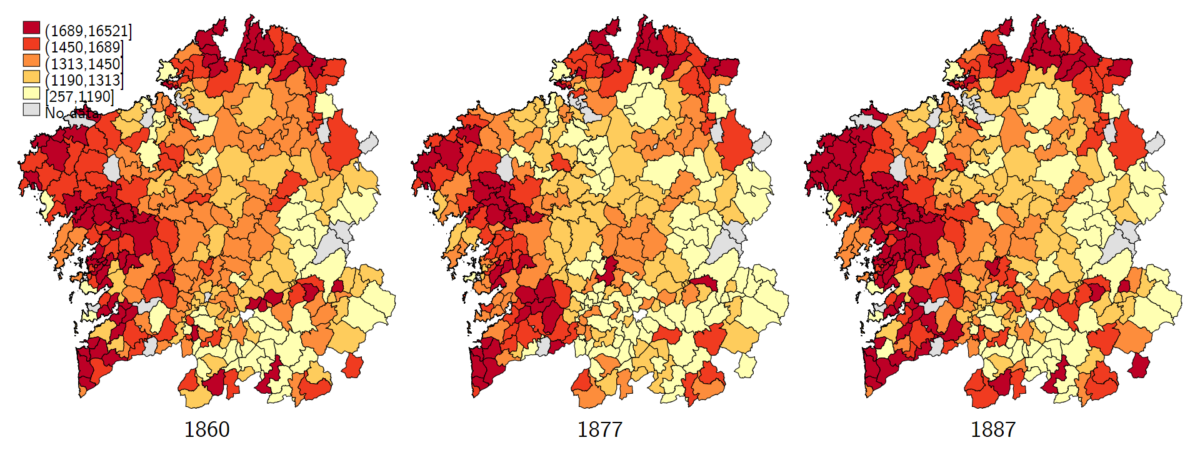
At the heart of this story is the Galician monte (communal scrubland). In the mid-1800s, nearly 75 per cent of the territory was held in common. These were not ‘wasted’ spaces; they were the very lungs of the peasant economy. A smallholder’s survival depended on the montes for grazing cattle, gathering firewood, and cutting gorse to fertilise their tiny private plots; the vital link between the ‘wild’ saltus and the cultivated ager. For the Galician villager, the commons were a safety net and a pillar of local autonomy.
This equilibrium was shattered by the Madoz Law (1855-1896). The liberal state, in its infinite wisdom, believed that by ‘liberating’ the land from the community and putting it under the auctioneer’s hammer, it would tether the peasant to a more productive, private future. It seems, however, that the Galician peasantry took this wake-up call quite literally: they woke up, looked at the new fences, and promptly boarded the next ship to Buenos Aires or La Habana.
To test this ‘disruptor’ thesis, I proposed that privatisation without broad redistribution would inevitably increase migration, and that the loss of communal resources would specifically drive landless and smallholding families to exit.
To test these propositions, I moved beyond the ‘administrative fiction’ of the municipality. By digitising thousands of original handwritten entries from the Registro de Fincas Vendidas (Registry of Sold Properties) held at the Spanish National Historical Archive (luckily, photos were already taken), constructed a novel municipal-level balanced panel of 316 councils observed across three census years: 1860, 1877, and 1887. This dataset tracks privatisation intensity (value per capita), the degree of buyer concentration, and the specific loss of communal assets.
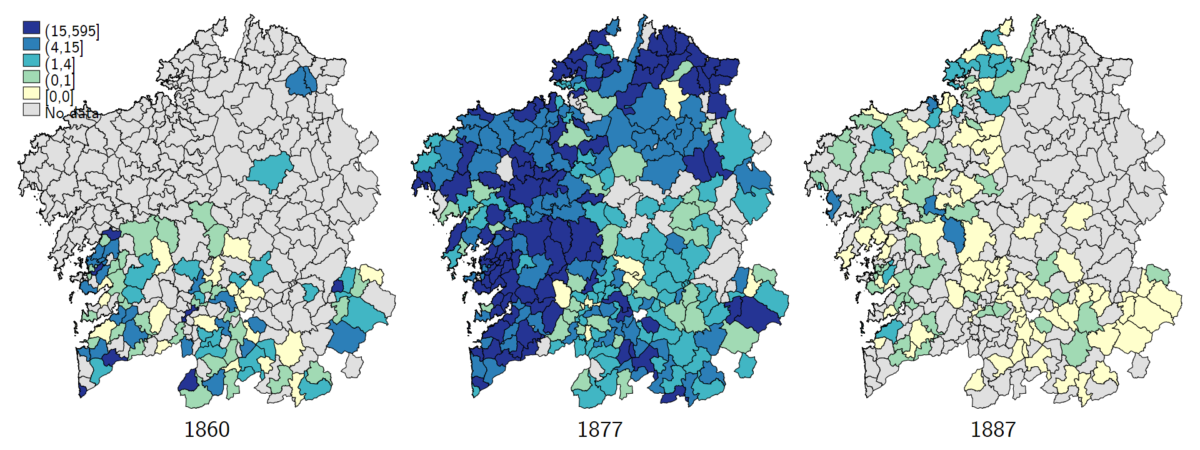
reales per capita.)
Methodologically, I argue that the municipality was often an ‘administrative fiction’ superimposed on a reality of fluid grazing rights. To account for these interdependencies, I employ a Spatial Durbin Model that allows me to disentangle ‘direct’ local impacts from ‘indirect’ spillovers. The rationale is that privatisation in one municipality may shift grazing pressure or labour supply to adjacent councils, creating a ‘regional saturation’ effect that closes off local safety valves.
The estimates reveal that depopulation was a contagious regional phenomenon. While local auctions had negligible direct impacts on their own, the simultaneous intensity of privatisation across neighbouring municipalities created a systemic regional shock. When neighbouring towns enclosed their hills, it closed off the informal safety nets of the hinterland, creating a ‘floating proletariat’ that was eventually propelled into the Atlantic migratory stream.
Crucially, the shock was profoundly gendered. By estimating gender-disaggregated models, I find that the elasticity of depopulation was notably higher for women than for men. In rural Galicia, women were the primary managers of the domestic subsistence economy; when the montes vanished, the material basis of female production (livestock and fuel) collapsed first. This ‘defeminised’ the social fabric as women were forced to exit earlier than their male counterparts.
Furthermore, my analysis reveals a ‘positive selection’ mechanism. For men, literacy served as a robust push factor, providing the transferable skills needed to navigate international labour markets. For women, however, literacy remained insignificant; their mobility was governed by the collapse of institutional constraints at home rather than human capital signals. The manner of the sale was equally vital: in districts where land markets were captured by a narrow elite (higher concentration of buyers), the displacement was far more severe, regardless of the total acreage. When elites monopolised the auctions, the peasantry was squeezed out by design.
Ultimately, the Galician experience serves as a cautionary tale for modern land-titling policies. It shows that when property rights are individualised without safeguards for those who rely on customary use, the result may not be development, but ‘demographic exhaustion’. In nineteenth-century Galicia, ‘secure’ property rights for a few were too often the primary catalyst for the flight of the many.
To contact the author:
Angel Muniz-Mejuto
Universidad Carlos III de Madrid
