Numeracy in everyday life: evidence from eighteenth-century Scotland
Home > Numeracy in everyday life: evidence from eighteenth-century Scotland
In this post, James Fox (University of Glasgow) presents research on everyday numeracy in eighteenth-century Scotland, supported by a Carnevali Small Research Grant from the Economic History Society.
—
How important were basic number skills in the lives of our ancestors? What role did numeracy play in processes of social and economic change?
These questions are central to the agendas of policymakers and historians alike. Recently, I have had the pleasure of examining evidence of everyday numeracy in eighteenth-century Scotland, with the support of a Carnevali Small Research Grant from the Economic History Society.
In today’s world, numeracy is recognised as an essential skill for navigating economic affairs. It can contribute to better financial decision-making, improved employment opportunities, and higher salaries. Viewed in a broader historical context, the development of numeracy has also been closely linked to economic growth.
Historians such as Jörg Baten have made a strong case for the connection between numeracy and human-capital formation. Their research identifies relationships between numerical reasoning and other indicators, including education, literacy, book ownership, and abstinence from violence.
The conventional way of measuring historical numeracy is through the so-called ‘age-heaping method’, which involves the quantitative analysis of datasets containing reported ages. In theory, a large sample should contain a relatively even distribution of ages: roughly as many 23-year-olds as 24-year-olds, for example, and similar numbers of people aged 46 and 47.
In the past, however, people often reported their ages using round numbers. A historical dataset might therefore contain more individuals who claimed to be 40 than either 39 or 41. This ‘heaping’ around particular ages is interpreted as a proxy for innumeracy, while the ability to report a precise age is taken as an indication of more general numerical competence.
My research takes a different approach. It examines the development of one particular form of numeracy: the ability to keep financial accounts.
The research focuses on records of debt litigation produced by burgh courts in eighteenth-century Scotland. These were small legal bodies, presided over by elected officials in Scottish towns, which handled minor civil and criminal cases, including disputes over debt.
The eighteenth century was a period in which banks generally catered only to wealthy individuals and firms, while relatively little physical specie was in circulation. As a result, much of the daily business conducted by ordinary people depended on informal credit agreements. When these arrangements failed—because borrowers defaulted or the terms of repayment were disputed—litigation in the burgh courts often followed.
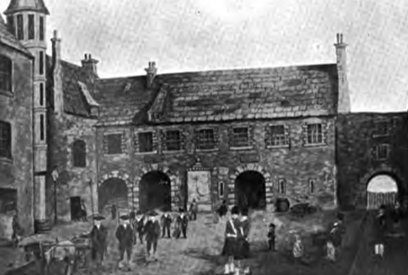
The documentation produced in these cases provides an intimate view of how people at almost every social level managed their financial affairs.
Crucially for this research, litigants sometimes brought forward their own financial accounts as evidence of indebtedness. These records provide a first-hand view of numeracy in action. They were rarely full-scale account books kept according to the technical methods prescribed in contemporary textbooks. Instead, they were often short lists of transactions written on single scraps of paper and used to calculate a total sum owed.
My early work on these cases suggests that accounts could play a significant role in determining the outcome of litigation.
In one case heard in Perth in 1770, a poor widow named Catherine Marshall stated that she was ‘greatly strained for money and having no other fund to raise money excepting my own silver buckles which cost ten shillings sterling’.
Marshall had given the defendant, James Douglas, the buckles as security for a loan of 1 shilling and 9 pence. She subsequently asked for the buckles to be returned or, alternatively, to receive their full value minus the outstanding 1s 9d.
She was able to prove that the loan had been made through the short account reproduced below, which Douglas had prepared for Marshall’s late husband. The relevant loan appears as the first transaction. Marshall was therefore able to use Douglas’s own account as evidence against him. The strategy appears to have been successful, as the dispute was settled out of court.
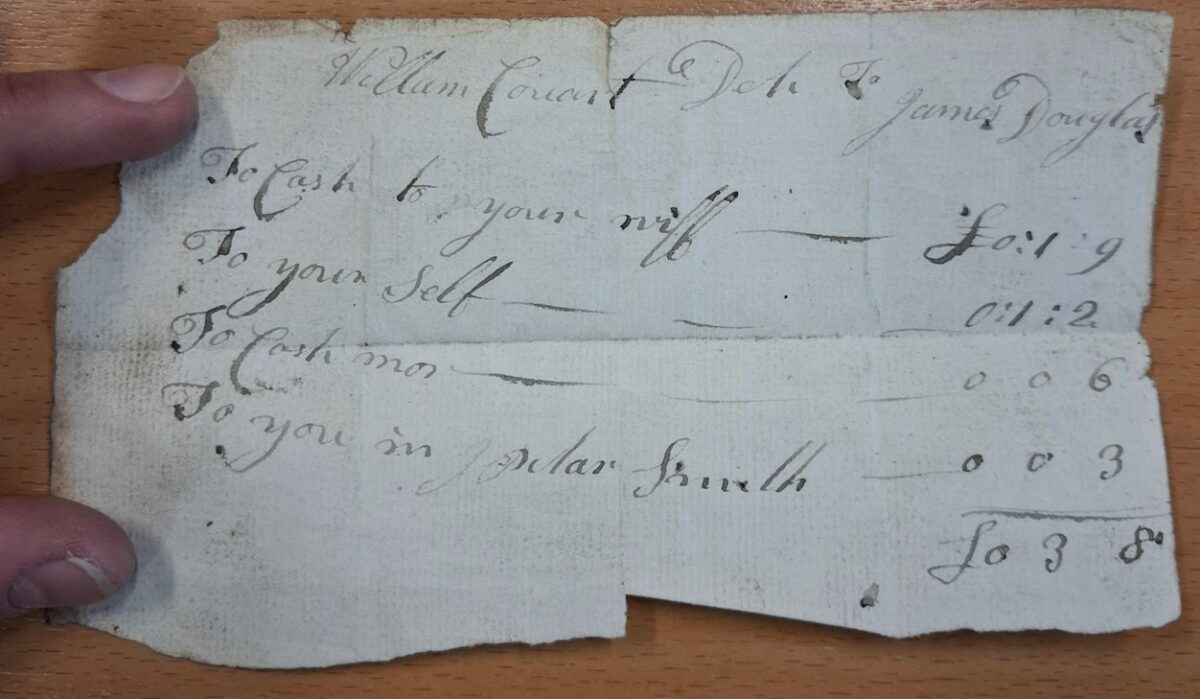
By quantifying how frequently such accounts were produced as evidence, and assessing the role they played during litigation, we have a potentially illuminating means of analysing the prevalence and practical value of everyday numeracy during a period of rapid economic expansion in eighteenth-century Scotland.
Although the quantitative analysis is still ongoing, it is already clear that accounting could play an important role in the economic lives of ordinary people. It mattered both in the conduct of daily trade and at moments when economic relationships broke down.
Once this evidence is incorporated into a broader analysis of change over time, it should become possible to understand how the everyday numeracy of people such as Catherine Marshall formed part of the much larger story of Scotland’s economic development.
To contact the author:
James Fox
james.fox@glasgow.ac.uk
University of Glasgow
Bluesky: @jamesafox.bsky.social
