Whatever Happened to Social History?
Home > Whatever Happened to Social History?
In this post, Richard Trainor (University of Oxford) with research assistance by Aris Grivokostopoulos (LSE) reflects on the Economic History Society’s first century, from the Centenary Conference session on the history of the Society (LSE, 11 April 2026). This research received the support of the EHS through its Initiatives and Conferences Fund.
—
‘Whatever happened to social history?’ The question has been asked at the edges of our discipline for a generation. The familiar story runs like this: economic history and social history, once close companions, drifted apart in the late twentieth century until they stood on opposite banks of a methodological river. A related impression holds that, although the Economic History Society has both economic and social history written into its constitution, social history now survives only at the margins of what the Society actually does.
For the Society’s centenary, I set out to test that story against the record. With the meticulous research assistance of Aris Grivokostopoulos of the LSE, work made possible by a grant from the Society whose support I gratefully acknowledge, we spent several months in the archives. We went through the Economic History Review itself, the conference programmes, the Council minutes, and the Society’s fellowship and committee records, sampling four moments in our history: the founding era of the 1920s and 1930s, the so-called golden age of the 1960s and 1970s, the difficult years from 1987 to 2005, and a pre-pandemic snapshot of the present in 2019. What we found complicates both halves of the conventional narrative.
To begin at the beginning: the Review was subtitled ‘a journal of economic and social history’ from its very first issue. Sir William Ashley’s 1927 programmatic article defined our subject broadly as ‘the history of actual human practice with respect to the material basis of life’. Strikingly, Ashley did not even use the phrase ‘social history’. To the founders, the social was simply part of the economic, and vice versa. The partnership of Eileen Power and R. H. Tawney — with its joint seminar, its roots in the Workers’ Educational Association, and its reformist sympathies — embodied that integrated vision. Whatever boundary anxieties the early Society felt were directed at pure theoretical economics on one side and high political history on the other, not at social enquiry.
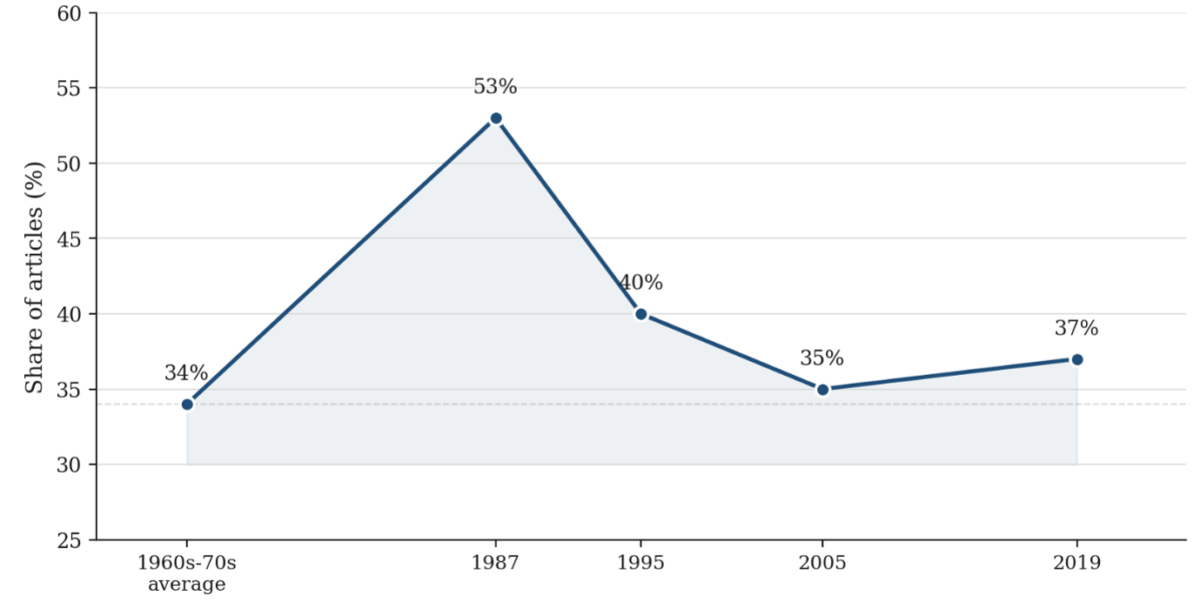
Pushing our enquiries into the later part of the period, the most surprising result was a quantitative one. Measured as a share of articles in the Review — counting both purely social topics and hybrid ones that combine economic and social questions — social history has been remarkably stable across the entire century. It averaged around 34 per cent in the 1960s and 1970s, briefly peaked at 53 per cent in 1987, settled into a band of 35 to 40 per cent through the late period, and stood at about 37 per cent in 2019. The claim that social history was pushed out of the Society does not survive contact with the evidence. The core topics — labour, demography, health, gender, and social structure — are as present today as they were in the days of Tawney and Power.
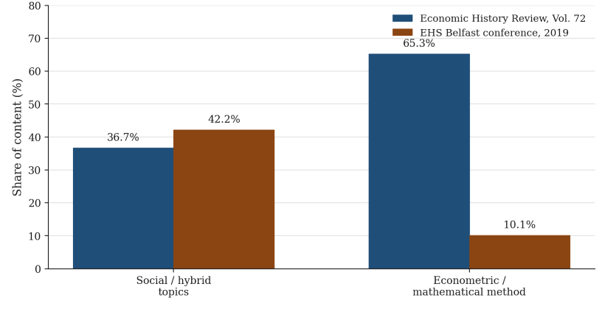
The 2019 snapshot is especially intriguing, because it shows our two main outputs pulling in different directions. Volume 72 of the Review was heavily mathematised, with roughly two-thirds of its articles econometric or mathematical in method, yet over a third remained devoted to social or hybrid topics. The Society’s 2019 Belfast conference, by contrast, kept far more qualitative space. Only about a tenth of its papers were highly mathematical, while more than two-fifths were social or hybrid, with dedicated sessions on Health and Welfare, Rural Poor Relief, and Women and Family Economics. The journal and the conference have diverged in method, but social topics endure in both.
Over the longer term, the genuine transformation was not in whether social questions were asked but in how they were answered. The narrative social history of the Hobsbawm and Thompson tradition — which was qualitative, argumentative, and heavily archival — gave way from the 1990s to a quantitative turn: anthropometrics and height data, demographic series, and dataset analysis of poverty, illegitimacy, and public health. The Society’s own editors saw it happening. As the 1994 Editors’ Report to Council put it, ‘the number of social history articles is quite healthy, though we seem to receive articles mainly on the more technical aspects of social history’. Social history did not disappear from the Society. It was transformed in method while preserved in subject.
The conclusion I draw is an optimistic one. Social history was never relegated within the Economic History Society. The Society continued to fund it, publish it, and host it, even as the EHS expanded its activities from the late twentieth century as the free-standing economic and social history departments in UK universities largely disappeared. Tawney lectures and fellowships alike support this conclusion. What social history in the Economic History Society became was a more technical, quantitative sub-discipline, distinct from the cultural turn that now predominates in the Social History Society, and sitting in comfortable coexistence with an increasingly mathematical economic history.
Today the phrase ‘social history’ is sometimes used rather quietly in the Society’s communications. After a century of evidence, I think it deserves to be spoken more loudly. There is real advantage in returning to our founders’ instinct for combining the economic and the social, the quantitative and the qualitative. The bigger the historical question, the more its answer requires all these approaches. As the Society begins its second century, it should not shy away from its social history side. It should acknowledge, and champion, its dual identity.
Rick Trainor is Provost of Rhodes House and a former Secretary and President of the Economic History Society. Research assistance by Aris Grivokostopoulos (LSE). This work was supported by a grant from the Economic History Society.
To contact the author:
Rick Trainor
richard.trainor@exeter.ox.ac.
Provost of Rhodes House, former Secretary and President of the Economic History Society
