When Financial Audits Becomes Political: Rethinking the Origins of Stalin’s Terror
Home > When Financial Audits Becomes Political: Rethinking the Origins of Stalin’s Terror
In this blog post Alex Royt (The Wharton School) presents their research, some of which will be presented at the upcoming EHS Conference.
—
Why do political purges sometimes follow episodes of economic disorder? Historians usually explain the Stalin’s Terror of 1936–38 as an episode of political consolidation or ideological radicalization within the Soviet state. In these interpretations, economic dysfunction appears mainly as background or as a convenient excuse. Stalin blamed “wreckers” and “saboteurs” for industrial failures, thereby shifting responsibility for unrealistic production targets onto managers and engineers. Terror, in this view, masked inefficiency.
My recent research suggests a more complicated story. Looking closely at archival material from the Kirov Plant in Leningrad, one of the Soviet Union’s largest defense enterprises, I find that investigations often began not with denunciations but with accounting irregularities. In 1936–37, auditors from the Commission of Soviet Control identified persistent discrepancies between invoiced production and actual inventory. Working capital exceeded planned norms by a substantial margin. Deliveries slowed even as reports claimed plan overfulfillment. These were not simply statistical anomalies; they reflected distortions in the mechanics of Soviet industrial finance.
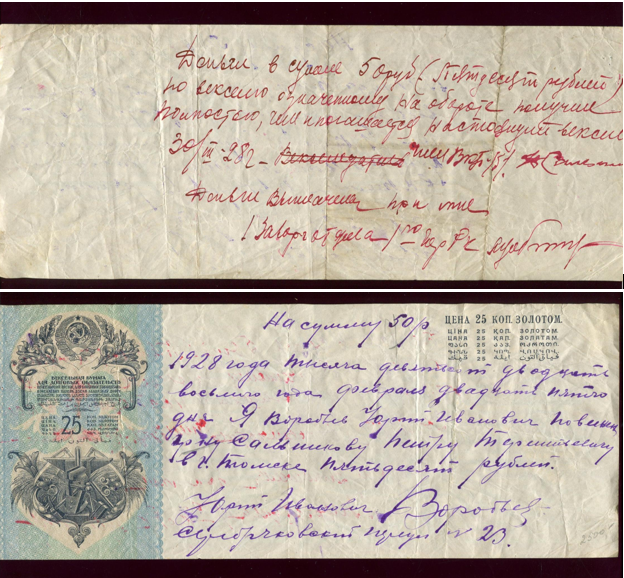
Enterprises settled payments using instruments known as “acceptances” and bills of exchange. Designed to coordinate deliveries and bank credit, these tools increasingly functioned as liquidity devices. Firms issued partial acceptances, deferred settlements, and circulated bills in ways that expanded access to funds beyond formal credit limits. The result was slow turnover of circulating capital, mounting receivables, the collapse of the armament program, and what banking officials described in April 1937 as vast sums of “frozen credit” and a “system of bypassing the bank.” It was discovered that the bureaucracy was subsidizing the informal “second economy” with cash and credit through an informally organized “second bank.” At the same time, none of the tanks and artillery equipment for that year had been delivered or finished.
These financial distortions were particularly consequential in defense production. The problem was not that buyers rigorously enforced quality while producers resisted, nor that factories simply sacrificed quality to meet quantitative targets. Official rejection rates in the military industry remained comparatively modest—not because defects were rare, but because formal rejection was administratively costly and politically risky. In planning statistics, “rejection” referred to non-acceptance under existing specifications, not to the absence of technical failure in operation. Even as rejection rates rose only slightly, moving from 6.3 percent in January to 7.1 percent in August 1936 in the Main Directorate of the Military Industry, with plants such as Kirov averaging 12.8 percent over eight months, official reports simultaneously admitted that the principal causes of rejection identified in 1935 continued unabated in 1936.
The explanation lay partly in procurement practices themselves. Military representatives were discovered not simply tolerating quality problems, but in some cases cooperating with enterprises in extracting liquidity from the banking system. As in the broader producer-goods sector, an invoice could be settled through a partial acceptance, with the remaining balance issued as a bill of exchange. The enterprise could discount this instrument at a savings bank, converting deferred settlement into immediate cash. Portions of this liquidity were then informally redistributed to military procurers or brigade commanders. Procurement thus became embedded in the same monetary circuits that were already weakening banking discipline elsewhere.
What began as administrative scrutiny escalated into disciplinary proceedings. In May 1937, the military purges in the Soviet Union began. By late 1937, the Kirov plant leadership was removed in coordination with the NKVD, and financial irregularities were reframed as intentional “wrecking.” This sequence does not suggest that terror was justified. The scale and violence of the Great Terror cannot be reduced to administrative housekeeping. But the evidence indicates that some investigations originated in real financial distortions rather than purely fabricated conspiracies. When accounting signals become unreliable, authorities responded with intensified scrutiny.
Economic historians often emphasize incentives and information. Political historians emphasize ideology and power. The events at the Kirov Plant suggest that, at times, these domains converge. Terror can emerge not only from grand strategy or paranoia, but from attempts, however misguided, to reassert control over a system whose financial signals no longer align with material reality. Understanding that interaction does not diminish the brutality of repression. It clarifies the pathway by which ordinary accounting disputes can become matters of state security.
To contact the author:
Alex Royt
alexroyt@sas.upenn.edu
Research Fellow; Business, Economic and Financial History Project; Wharton Initiative for Financial Policy and Regulation; The Wharton School (USA).
