A Millennium of Money Supply in China, 618–1911
Home > A Millennium of Money Supply in China, 618–1911
In this blog post Yangyang Liu and Zoey Shen (London School of Economics) present their research, which was supported by the EHS through the Carnevali Small Research Grants Scheme.
—
How much money circulated in imperial China, and what difference did it make to the shape of the economy? The question is simple enough but answering it is not. Money lies at the centre of some of the largest problems in economic history. As a key macroeconomic indicator, the money supply shapes inflation, interest rates, and broader patterns of economic growth, stagnation, and deflation. While monetary dynamics have been extensively studied in Western contexts—most notably in the work of Milton Friedman and Anna Schwartz, as well as historical reconstructions by Angus Maddison—there remains a striking gap in the systematic study of long-run money supply in China. This is surprising given that China is one of the few civilisations with continuous monetary records spanning more than two millennia, yet these data have never been comprehensively compiled or standardised.
This project proposes to construct the first unified, long-run database of money supply in China, covering the period from 618 CE, marking the beginning of standardised coinage in the Tang dynasty, to 1911, the end of the Qing dynasty. By assembling fragmented archival evidence on copper coins, paper money, silver circulation and regional monetary forms of the time, the project will provide a new empirical foundation for the study of Chinese and global economic history.
Preliminary Findings
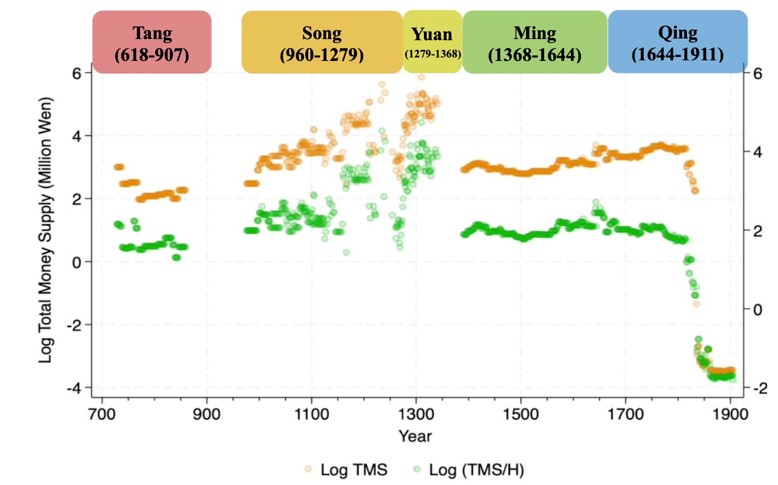
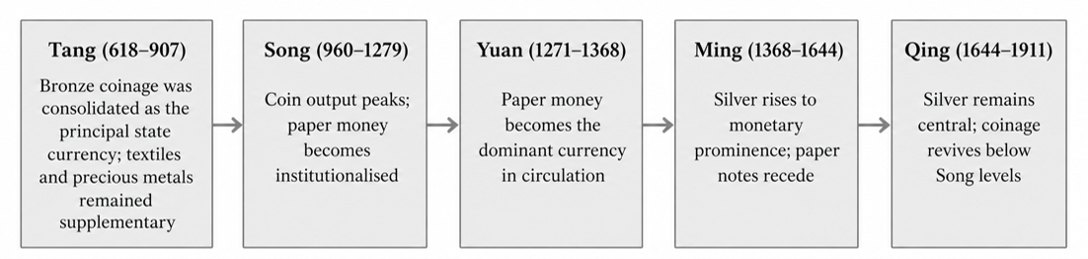
Even at a preliminary stage, the findings are suggestive. Bronze coinage emerges as the enduring backbone of state money from the Tang onwards, though its scale varied dramatically over time. Our current reconstruction indicates that annual coin output reached a peak of 5.006 million strings in the Northern Song, a striking figure that points to Song China as one of the most highly monetised economies of the premodern world. Although coin production resumed under the Ming and was revived more energetically under the Qing, neither appears to have matched the scale of Northern Song issuance.
Paper money presents an equally remarkable story. Its earliest forms can be traced back to the Tang, but it was under the Song that paper currency was properly institutionalised and woven into a commercially expansive economy. Under the Yuan, its use expanded further and at times became dominant. China thus occupies a central place in the global history of monetary innovation. At the same time, the late Song and Yuan experiences offer a reminder of the dangers of overissuing, when expanding circulation outruns fiscal discipline and public confidence. In that sense, imperial China was not merely an early adopter of paper currency, but one of the great historical arenas in which its possibilities and limits were tested.
The rise of silver under the Ming and Qing, meanwhile, reveals how closely Chinese monetary history was tied to wider currents of global exchange. Compared with Europe, where precious metals had long held a formal monetary role, silver became central in China relatively late. Once it did, however, it linked the Chinese economy to bullion flows from Japan and the Americas, as well as to the wider commercial world of the Manila galleon trade, while also drawing on domestic production in the southwest. The history of money in China is therefore also a history of global integration.
A further finding is that imperial China’s monetary world cannot be understood through official state currencies alone. Regional and informal forms of money also mattered. Iron coinage, especially in the Song, appears to have played an important role in particular local settings, reminding us that monetary circulation was uneven, regionally differentiated, and more complex than a purely state-centred account would allow.
The larger importance of the project lies in what this reconstruction will make possible. A reliable long-run series will allow historians to approach the relationship between money supply, prices, and economic activity in China with far greater precision. It will also strengthen comparison with Europe, particularly in debates over the Great Divergence, market development, and institutional developments. More broadly, it will help place China where it belongs in the comparative quantitative history of the global economy.
We are deeply grateful to the Economic History Society for supporting the work that has made this stage of the work possible. That support has enabled us to move beyond scattered figures and isolated case studies towards a more systematic reconstruction of the largest dataset on money supply in China. We hope the resulting dataset will serve as a valuable resource for scholars researching global comparative economic history.
To contact the authors:
Yangyang Liu
London School of Economics
Zoey Shen
London School of Economics
