
Child labour in cotton factories during the Industrial Revolution
Home > Child labour in cotton factories during the Industrial Revolution
In this post Xuesheng You (Cardiff University) and Alex Tertzakian (University of Glasgow) present their research, which was supported by the EHS.
—
Child labour formed an integral part of the workforce that ignited and sustained the British Industrial Revolution (Humphries 2010). Its importance was particularly evident in textile manufacturing. It was essential for filling labour shortages in early textile factories and continued to supply cheap labour to textile production even as steam power became more widely adopted in the nineteenth century (Honeyman 2016, Nardinelli 1990). Recent studies show that, despite rising adult male wages, advancing technology, and restrictive factory legislation, the use of children in factories intensified at least until the mid-nineteenth century, with nearly 60,000 children under the age of 13 still employed in textile factories in 1851 (You and Tertzakian, 2026).
Child labour has been a focus for social observers since the start of the industrial age. Today, many studies across history, economics, and the social sciences aim to understand its causes and effects. Despite this, consensus remains elusive, mainly due to limited empirical evidence on the historical aspects of child labour.
Three main types of sources have been used so far to study child labour during the British Industrial Revolution: parliamentary inquiries, decennial censuses, and working-class autobiographies. Each source offers valuable insights, but all have intrinsic limitations. For instance, parliamentary inquiries were often agenda driven. Decennial censuses provided no wage information. Working-class autobiographies offer rich contextual information on child labour relating to household demographics and socioeconomic conditions. However, the number of observations is inevitably small.
Given these source limitations, it is perhaps surprising that there has been little effort to analyse child labour in the textile industry directly from factory employment records. This research aims to bridge this gap. Based on extensive research, the only two mills with employment records containing rich, systematic information on child labour are Quarry Bank Mill (hereafter QBM) in Styal, Cheshire, and the Strutt Mills (hereafter SM) in Belper, Derbyshire. Both were large-scale cotton factories at the technological frontier of their day. We have identified three types of employment records from these two mills that can be used to study child labour: children’s age certificates, school attendance records and wage books.
Both children’s age certificates and school attendance registers were by-products of the Factory Acts, which aimed to limit child labour. From 1844 onwards, it became a legal requirement for any factory employing children to obtain and retain a child’s age certificate from the certifying surgeon. These certificates record children’s names, their parents’ names, and their place of residence when they joined the factory workforce. They survive for those aged 8 to 12 in QBM between 1844 and 1854, and in SM between 1844 and 1872.
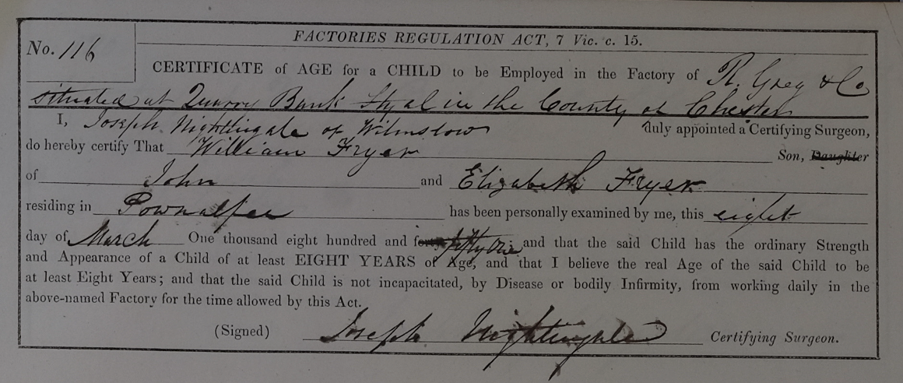
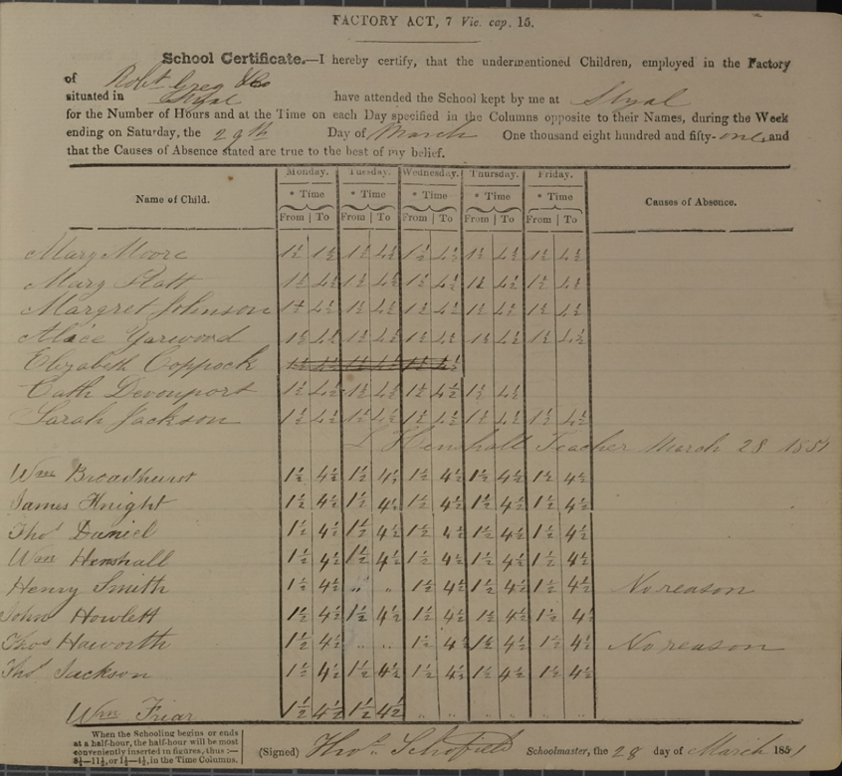
The school attendance registers record the daily school attendance of child workers aged 8 to 12. If those children were employed at the factory, they would appear in the school attendance registers, per the legal requirement. These records survive in QBM between 1849 and 1855. In SM, they survive between 1839 and 1899. With these two types of records, we can ascertain the size of the child labour force; estimate the average age at which children started working; and calculate the duration of children’s employment in cotton factories.
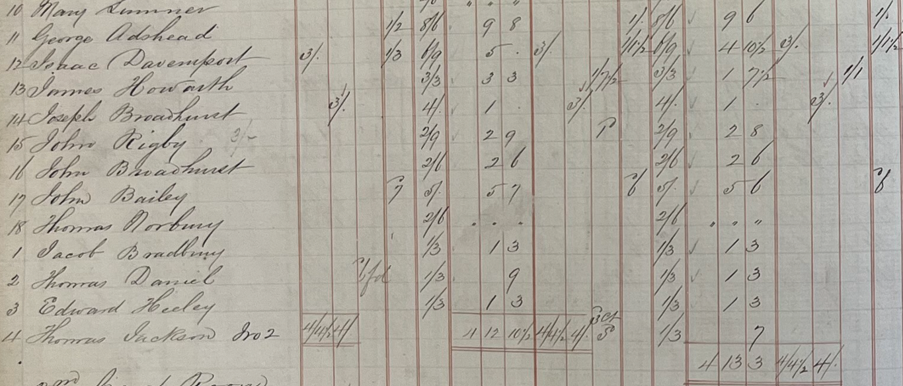
The wage books report employees’ weekly wages and their employment department. They survive, with some gaps, between 1789 and 1906 in QBM. In SM, they survive between 1826 and 1835, and then between 1882 and 1900. With the weekly wage books, we can analyse child-adult earnings ratios, changes in children’s earnings over time, and how much their experiences of childhood employment increased their earning premium in adulthood. Together with production records from these two factories, we can estimate changes in children’s labour productivity given technological changes over time. By linking children found in the wage books with the census, we can also estimate how much children contributed to household economies at different life-cycle stages.
With generous support from the Carnevali Small Research Grant, we collected and transcribed these records. They will significantly enhance our understanding of child labour in a key industry during the Industrial Revolution. We are now analysing the data and preparing a submission for the Economic History Review.
References:
Honeyman, K., Child workers in England, 1780-1820: parish apprentices and the making of the early industrial labour force (London, 2016).
Humphries, J., Childhood and child labour in the British Industrial Revolution (Cambridge, 2010).
Nardinelli, C., Child labour and the Industrial Revolution (Bloomington, 1990).
You, X. and Tertzakian, A., ‘Child labour and industrialization: Evidence from factory records and the 1851 British census’, Economic History Review, 79 (2026), pp. 163–188.
To contact the authors:
Xuesheng You
Cardiff University
Alex Tertzakian
alexander.tertzakian@glasgow.ac.uk
University of Glasgow
