
Hikiagesha Repatriation
Home > Hikiagesha Repatriation
In this post Kristian Honey (MPhil candidate in Economic and Social History at the University of Oxford) explores the economic and social reintegration of Japan’s six million repatriates after 1945, revealing how their experiences shaped postwar recovery and policy reform. This research was supported by the EHS.
—
At the conclusion of the Asia-Pacific War, more than 6.3 million Japanese citizens, accounting for almost 10% of the population of Japan proper, were repatriated from the country’s former colonies and occupied territories. This was, as historian Shinzō Araragi has called it, “one of the largest migration moments in history”. Yet this dramatic upheaval has often been overlooked in studies of postwar Japan, overshadowed by the legacy of the Allied occupation and the region-defining civil wars in China and Korea.
Where research has focused on repatriation, it has primarily focused on the logistics of repatriation, and the memory of hikiagesha as marginalised victims—ostracised as outsiders to the mainland’s devastation from US bombing campaigns and as reminders of the militarism that led to it. As a result, the repatriation leaves a legacy, according to labour historian Andrew Gordon, “not yet fully studied or understood”.
My project examines the economic and social reintegration of repatriates in the first decade after Japan’s defeat. As many primary sources suggest, a majority of hikiagesha were absorbed into postwar Japanese agriculture, supporting food production after the collapse of imports from the former colonies. Yet this finding, drawn from an early national snapshot study, raises as many questions as it answers. The repatriates had highly diverse prewar backgrounds: some were farmers, but many others were engineers, civil servants, and industrial workers.
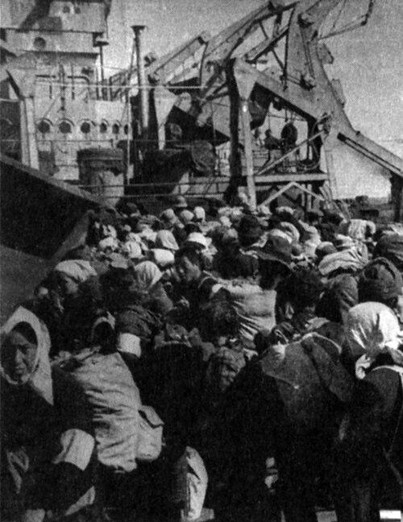
One explanation lies in U.S. occupation policy and local land reform. Redistribution measures created opportunities for repatriates to take over farmland, while rehabilitation loans—known as kōsei shikin—encouraged small-scale agricultural ventures. At the same time, not all repatriates actually returned when the war ended. Thousands of skilled technicians and engineers were retained in northeastern China to assist in rebuilding industry under the emerging Communist administration. When they eventually returned to Japan, many brought back ideas about rural organisation, labour mobilisation, and collective reconstruction drawn from those experiences. In diary accounts and postwar memoirs, some are described as having helped to implement and advocate for Japan’s own democratising land reforms under the U.S. occupation, hinting at how the upheavals of defeat and decolonisation produced unexpected continuities and channels of knowledge exchange in labour, expertise, and reform across the postwar Asian landscape.
To understand this process, I draw on survey data, repatriate interviews, and records of local policy and land reform measures. Together, these sources allow a more granular picture of how individuals navigated the economic dislocation of defeat. Quantitative data reveal broad employment trends, while personal testimonies from museums and prefectural archives capture the lived realities of displacement, resettlement, and adaptation.
Beyond Japan, the study speaks to broader debates on forced migration. While economists and historians have examined the integration of voluntary migrants, less attention has been given to those displaced by war or political change. In today’s world, where forced displacement has reached record levels, examining how Japan absorbed a population influx equal to nearly ten percent of its total population in a short period provides comparative lessons. This project aims to bring the economic experiences of repatriates into sharper focus within both Japanese and global economic history, highlighting the uncertainty of the late 1940s and the human efforts behind recovery—reminding us that Japan’s postwar resurgence was neither inevitable nor uniformly experienced.
At the same time, I believe this study will be fruitful for the broader literature on migration and displacement. While the integration of immigrants into host economies has been a major theme in migration studies, far less attention has been paid to those forcibly displaced by wars and natural disasters. Amid an international climate where the number of forcibly displaced individuals has reached a historic high of over 110 million and is expected to rise further with climate change, understanding how a devastated Japan absorbed what amounted to more than seven percent of its population can provide valuable insight into large-scale reintegration and recovery.
To contact the author:
Kristian Honey
https://www.linkedin.com/in/kristarohoney/
University of Oxford
