Land and Capital in Scotland, 1685-1914
Home > Land and Capital in Scotland, 1685-1914
In this post Tom Pye (University College London) presents their research, which was supported by an Economic History Society Carnevali Small Research Grant.
—
Scholarship on wealth-holding across the ‘pre-industrial’ world is flourishing. But finding data on the role of landownership in the story can be difficult. Most countries did not have estate taxes of the kind that have been successfully analysed by historians and economists in France. Historians of wealth inequality in Britain have drawn on early modern ‘social tables’ and, more recently, probate inventories—records of wealth-at-death. Yet there are limitations to using probate inventories for the eighteenth and nineteenth century. Land remained the primary source of wealth in Britain until the 1890s. But before 1896, probate records included neither assets held in trust nor land of any kind.
Landownership was not publicly registered in England and Wales, with a few exceptions: Middlesex and the three ‘ridings’ areas of Yorkshire. Periodic attempts were made at centrally registering titles to English landownership from 1862 onwards. But registration only became compulsory for purchase in 1990, and for inheritance in 1996. Between c.1650-c.1890, most English landowners used a trust called the ‘strict settlement’ to transfer land to their progeny. Each settlement created an ‘entail’, a type of land grant used by landowners across the European empires to prevent the break-up, sale, mortgaging, or leasing of their estates. There is no register of these trusts in the English archive. When estimating the proportion of English land locked up in these trusts between the seventeenth and nineteenth century, historians rely on the estimates of contemporaries, who themselves lacked any meaningful data. In the 1850s, the best estimates of the proportion of English land held under settlement ranged from 66% to 90%.
Land trusts worked in a different way in Scotland, which has always had a different legal system to England. The Scottish equivalent of the English strict settlement was the strict entail, or ‘tailzie’. One estimate from 1828 put the proportion of tailzied Scottish land at 50% and growing. But there was a difference. From 1685 onwards, landowners had to register any entails to take advantage of the legal protections they offered to their estates. The Scottish archive holds a record of every entail made and registered in Scotland between 1685 and 1914. Thanks to the generosity of the Economic History Society’s Carnevali Small Research Grants scheme, I have received funding for a pilot project that will digitise, clean, and map this registration data. A key element will be to test the potential of new AI-aided Optical Character Recognition (OCR) technology to extract data from manuscript sources that have never been subjected to large-scale quantitative analysis. Carnevali funding will also fund archival sampling of four further sources to test the viability of the pilot’s methods for conducting a larger-scale collaborative project on the long-run history of wealth distribution in Britain between 1707 and 1914.
My pilot project will address two sets of research questions around the distribution and repatriation of capital in eighteenth- and nineteenth-century Scotland.
We still know very little about the distribution of land and how it changed over the course of industrialisation. The Occupational Structure of Britain project is showing that English industrialisation was well advanced by 1700. But Scottish industrialisation came later, in the late-eighteenth and early-nineteenth century, and was more condensed. Tracing the rate and scale of entailment in eighteenth- and nineteenth-century Scotland will enable a better understanding of top wealth shares in Scotland during its telescoped industrialisation, which was also a period of British imperial aggrandisement. It will also allow the project to show whether – and how – the sectoral composition of Scottish landownership changed over the same period.
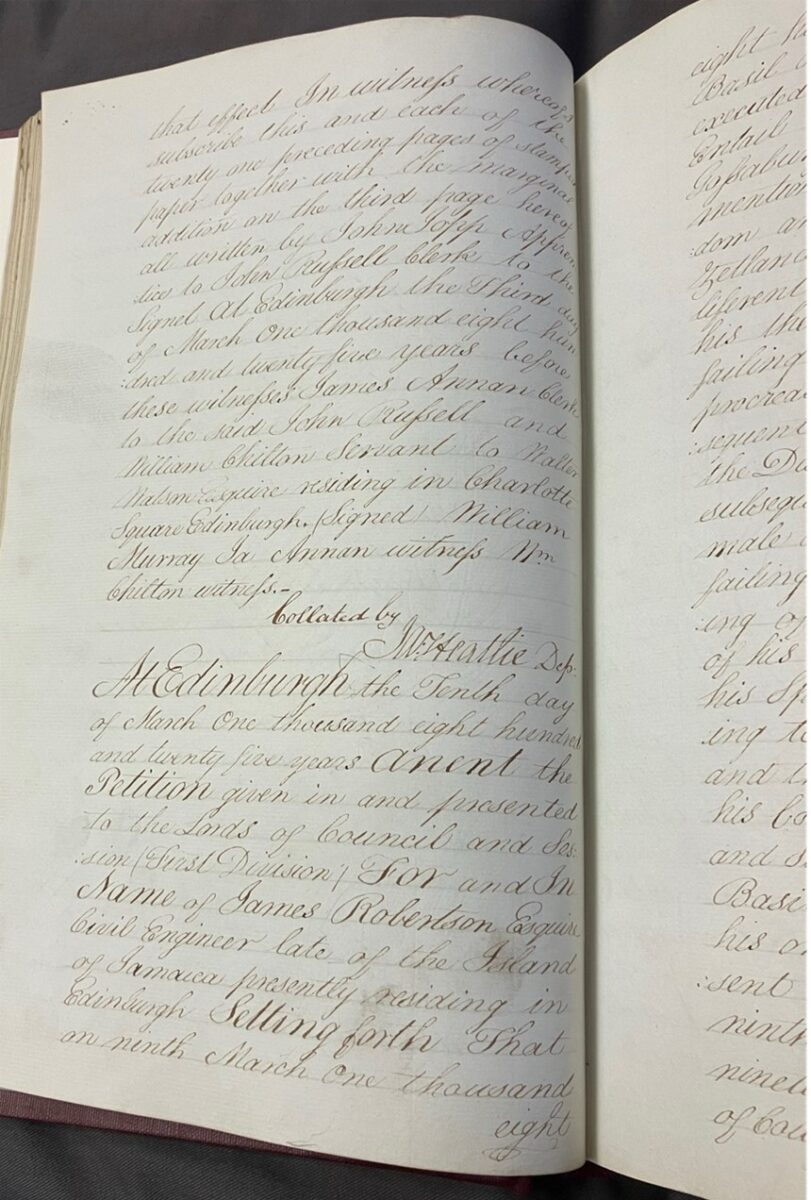
The second set of research questions concerns the transformation of empire-derived wealth into British land. This could happen in two ways: either directly through land transfers followed by entailment, or indirectly through mortgage lending. Data in the entail records, observable in Figure 1, will allow the project to answer the question of how many entailed estates were linked to empire-derived wealth, building on recent work on Scotland’s public buildings.
As well as producing a research article drawn from the project, I intend to publish the cleaned data and map series online. I hope that the data will be valuable to economists and economic historians, historians of Britain, and the general public—particularly in Scotland, where the importance of land to wealth inequality is keenly felt.
To contact the author:
Dr Tom Pye
tom.pye@ucl.ac.uk
University College London
