
Second City History and Economics Meeting (SCHEMe), Vol. 3
Home > Second City History and Economics Meeting (SCHEMe), Vol. 3
In this post, Eric Melander of the University of Birmingham presents a summary of Volume 3 of the Second City History and Economics Meeting (SCHEMe), which took place at Birmingham Business School in June 2026 and was supported by the EHS Initiatives and Conference Fund.
—
On 25-26 June 2026, Birmingham Business School welcomed two dozen or so academics who, in the middle of one of this summer’s many heatwaves, braved the uncharacteristically warm West Midlands weather for two days of economic history. Among them were a mixture of presenters – made up both of Birmingham “locals” and guests from across the country – and other participants keen to hear about the latest research in the field.
The occasion which brought them to Birmingham was the third volume of the “Second City History and Economics Meeting (SCHEMe)”. This event, which I have organised annually since 2024, is an initiative by the department of Economics at Birmingham Business School to foster knowledge exchange and the development of research ideas and collaborations in economic and social history across UK institutions. The aim of the meeting is to bring together scholars at all career stages (from PhD students to full professors) on equal terms, giving each speaker ample time to present and receive constructive feedback on their research.
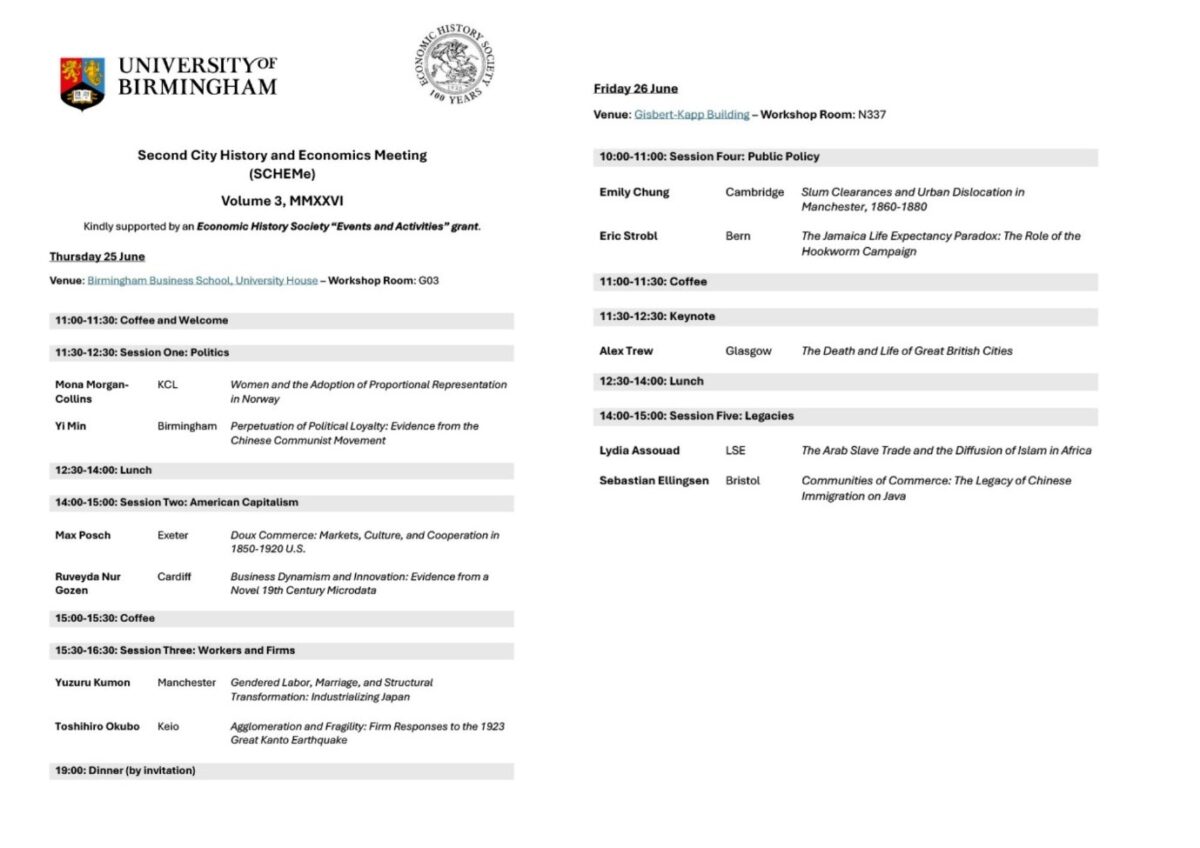
In conceiving the event, I self-indulgently strove to put together the kind of programme I myself most like to attend: one which is eclectic in terms of themes, open-minded in terms of methods and transdisciplinary and forward-looking in scope. As reflected in the programme (Figure 1), this year’s edition – made possible by the generous support of the Economic History Society through the Initiatives and Conference Fund – ticked all those boxes. The speakers were drawn from across disciplines (from economics via political science to history and geography) and their presentations spanned many geographies and epochs.
My opening remarks at each edition of SCHEMe almost invariably begin with some version of noticing that the roots of economic history run deep at Birmingham. Indeed, Sir William Ashley – a key figure in British economic history and the first president of the Economic History Society – took the first chair of Commerce at the University in 1901. Such traditions are worth remembering and celebrating, especially in this centenary year of the Society.
Over the course of the two days, in sessions which sometimes tenuously paired presentations (the main drawback of actively promoting an eclectic programme!), we heard about:
- Politics: Mona Morgan-Collins (KCL) on women and proportional representation in Norway; Yi Min (Birmingham) on persistent loyalty in the Chinese communist movement
- American Capitalism: Max Posch (Exeter) on how culture is shaped by markets; Ruveyda Nur Gozen (Cardiff) on innovation and business dynamism
- Workers and Firms: Yuzuru Kumon (Manchester) on gendered labour as a wedge in structural transformation; Toshihiro Okubo (Keio) on firm responses to the Great Kanto Earthquake
- Public Policy: Emily Chung (Cambridge) on slum clearances in Victorian Manchester; Eric Strobl (Bern) on the Jamaican hookworm campaign
- Legacies: Lydia Assouad (LSE) on the role of the Arab slave trade in diffusing Islam in Africa; Sebastian Ellingsen (Bristol) on the impact of Chinese immigration on Javanese development
As the centrepiece of the meeting, it was a pleasure to welcome Alex Trew (Glasgow) as this year’s keynote speaker. His presentation on the “Death and Life of Great British Cities” was a tour de force of modern quantitative economic history. Alex and his coauthors ask a question central to understanding the fate of cities over the long run: what are the dynamic consequences of industrial concentration on productivity? Mustering vast new data to track British cities over multiple centuries and embedding these in a quantitative spatial model, they find evidence of significant dynamic cross-industry (Jacobs) externalities that can explain over 40 percent of today’s North-South productivity divide.
The loose theme of the meeting was “novel data and approaches in quantitative economic history”, which was reflected not only in the breadth of the presentations over the course of the two days, but also in the vibrant discussions that carried over to the breaks, lunches and evening social. A clear takeaway from the various conversations was that, on a practical level, advances in computing can and will reshape how our discipline works and how we go about trying to find answers to the questions that matter. Plus ça change, in a way, but the capabilities of AI clearly represent an unprecedented step-change. Even so, the business of asking the right questions and doing careful (economic) history remains fundamental, as it always has done.

To contact the author:
Eric Melander
e.melander@bham.ac.uk
University of Birmingham
