
The Nature of Crime and its Relationship with Women in Northeast England, 1853-1888
Home > The Nature of Crime and its Relationship with Women in Northeast England, 1853-1888
In this blog post Kerri Armstrong presents their research, which was supported by the EHS through its Research Fund for Graduate Students.
—
On a warm June afternoon in 1882, a woman is transferred to Durham County Gaol, marking the start of her five-year conviction. Upon arrival, she is positioned in front of a camera in the standardised institutional pose, shoulders squared slightly to left, gaze directed towards the photographer, hands visible across her abdomen. This modest image, likely the only photograph ever taken of her, captured Charlotte Bell’s physical identity and now sits in the National Archives, preserved and stored under similar institutional rules and record‑keeping practices that structured her life within the penal system.
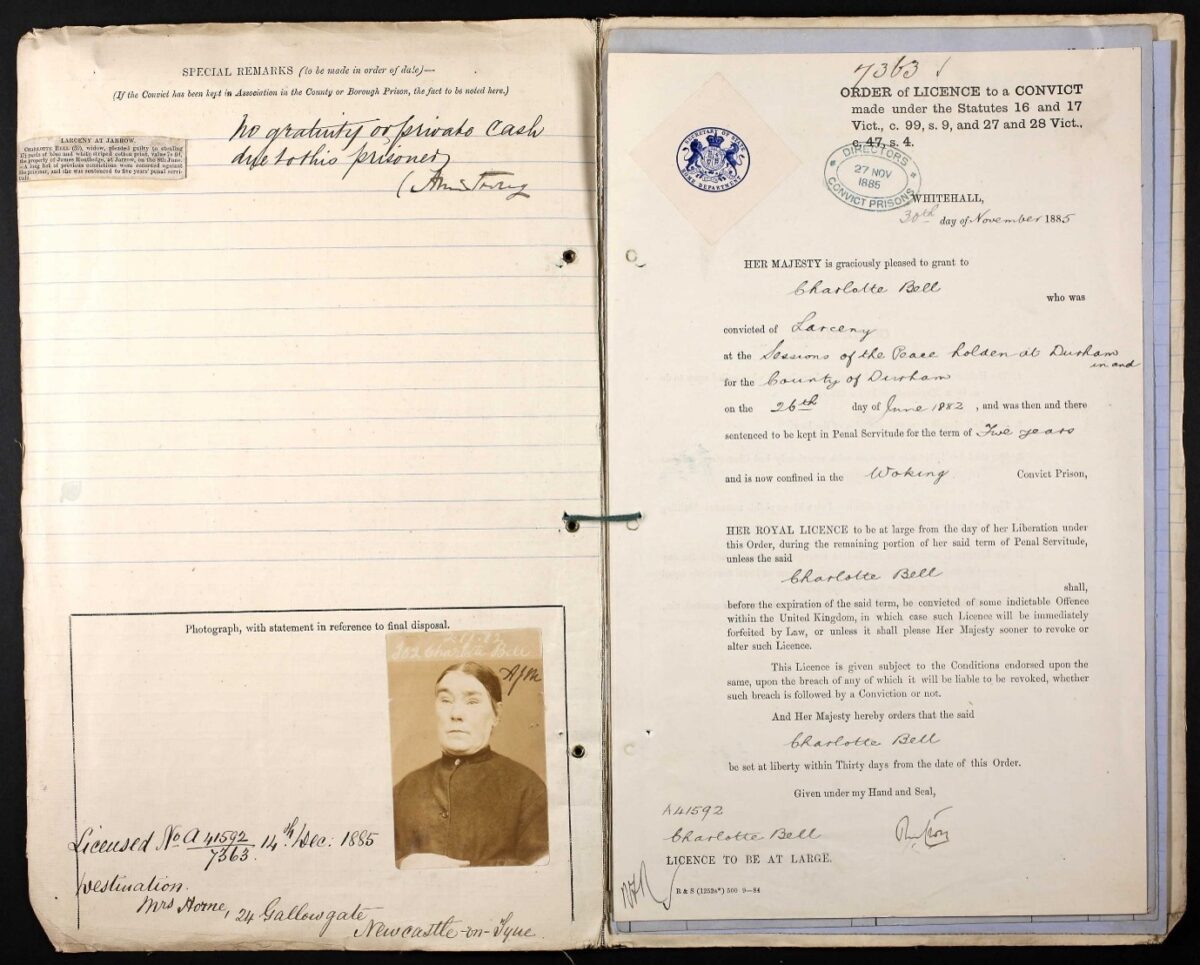
Bell’s photograph is one example of the material that forms the basis of my PhD research. I examine the parole files of 213 women convicted by the Session and Assizes Courts of Durham, Newcastle and County of York between 1853 and 1888, exploring the nature of crime and its relationship with women in northeast England. These files contain varying degrees of information including personal details, criminal history, medical history and, from 1870, photographs. Together, they offer an insight into the nuances of female offending by situating female criminal behaviour within the wider economic, social and cultural contexts of their lives.
The nineteenth century saw the criminal justice system undergo significant change and administrative expansion. Transportation sentences ceased and convict prisons were built, new forms of surveillance were introduced, and the professionalisation of penal administration created an environment in which information became central to governing offenders. The parole files created for both men and women, were designed to track criminal behaviour, record personal information, and support decisions about release and rehabilitation. As the century progressed, officials developed increasingly standardised forms and procedures, reflecting a growing belief that criminality could be understood and managed.
The parole records are material products of the changing penal system. They are not passive documents, instead, they are objects of legal authority, shaped by the procedures and classifications of the justice system. During my initial analysis of the female parole files, a methodological question began to emerge: were these records constructed or treated differently for women than for men? In other words, did gender shape not only the content of the files, but the administrative processes behind them in what was being recorded, how it was organised, and what officials considered important? This question cannot be answered from the women’s files alone. To understand whether gender influenced record‑keeping practices, I needed to examine a comparative sample of men’s parole files from the same courts and period. The EHS funding made it possible to travel to The National Archives and over several days, I consulted the men’s files, noting their structure, the types of documents included, and any descriptive categories used.
Gender was fundamental in the shaping of opportunities, expectations and marginalisations within an individual’s life, and therefore must be placed at the centre of criminal analysis. Female criminality cannot be analysed without the consideration of gender power structures and how it shapes the criminal justice system. Female offenders were considered ‘doubly deviant’, they were not simply individuals who had broken the law, but women who had broken the moral and gendered social expectations (Zedner, 1991). If such assumptions influenced how officials documented offenders, then the parole file becomes more than an administrative tool, it becomes a space where gendered expectations were reproduced and reinforced. Comparative archival work is essential for identifying these patterns. By placing men’s and women’s files side by side, it becomes possible to see which features were standard administrative practice and which may have been shaped by physical gender differences, such as childbirth or ideological gendered assumptions. This approach offers a more nuanced understanding of how the justice system categorised offenders and how those categories influenced decisions about release and supervision.
This funded visit has provided the foundation for this comparative work and now that I have examined both sets of records, I can begin to explore deeper how gender assumptions underpinned the practices through which officials documented offenders’ lives, behaviour and rehabilitation, and how these practices shaped women’s experiences of crime in northeast England.
References:
Lucia Zedner, Women, Crime and Custody in Victorian England (Oxford Clarendon Press: Oxford, 1991).
To contact the author:
Kerri Armstrong
Email: kerri.armstrong@northumbria.ac.uk
Northumbria University
