
Volatility, distributive conflict, and economic policy in Argentina’s long run
Home > Volatility, distributive conflict, and economic policy in Argentina’s long run
In this blog post Ana Laura Catelen (Universidad Carlos III de Madrid and Universidad Nacional de Mar del Plata) presents their research, some of which was presented at the recent EHS Conference.
—
Why did Argentina, once among the world’s richest economies, fall behind over the course of the twentieth century? This question has long occupied economic historians. One important clue lies in the persistent rise in macroeconomic volatility. Unlike in many comparable economies, instability in Argentina did not fade with time, but intensified from the mid-twentieth century, leaving a deep imprint on economic performance.
Latin American structuralist economists have long argued that volatility is not merely the outcome of bad luck or policy mistakes, but the result of recurrent internal tensions operating under a binding external constraint. A central mechanism in this tradition is structural distributive conflict: the gap between workers’ wage aspirations and the level of real wages compatible with external balance. When wages rise faster than productivity and export capacity allow, external deficits emerge, triggering adjustment through devaluation or recession. These adjustments compress real wages, only for distributive pressures to reappear once growth resumes. The result is a stop-and-go dynamic that amplifies instability.
My paper revisits that structuralist insight and asks whether such distributive conflict can help explain Argentina’s long-run volatility, and, through it, its disappointing growth performance. It does so by combining a long historical perspective with a systematic analysis of macroeconomic interactions, based on newly reconstructed and harmonised annual macroeconomic series spanning 1880–2020. Crucially, the paper brings economic policy explicitly into the picture.
Economic policy has always occupied a central, if contested, place in debates about Argentina’s development. Was growth undermined by excessive intervention, or by repeated liberalisation? Were policy swings the cause of instability, or merely a response to deeper structural constraints? Rather than treating policy as a long-run growth determinant, this study approaches it as a key component of short-run macroeconomic dynamics.
To capture this dimension, the paper develops a novel index of economic policy orientation, tracing shifts between more interventionist and more liberal stances across fiscal, monetary, exchange-rate, trade, capital-account, regulatory, and privatisation policies. Built from a historical meta-narrative spanning 140 years and more than a hundred pages of documented public actions, the index allows policy changes to be analysed alongside movements in real wages, the real exchange rate, and output.
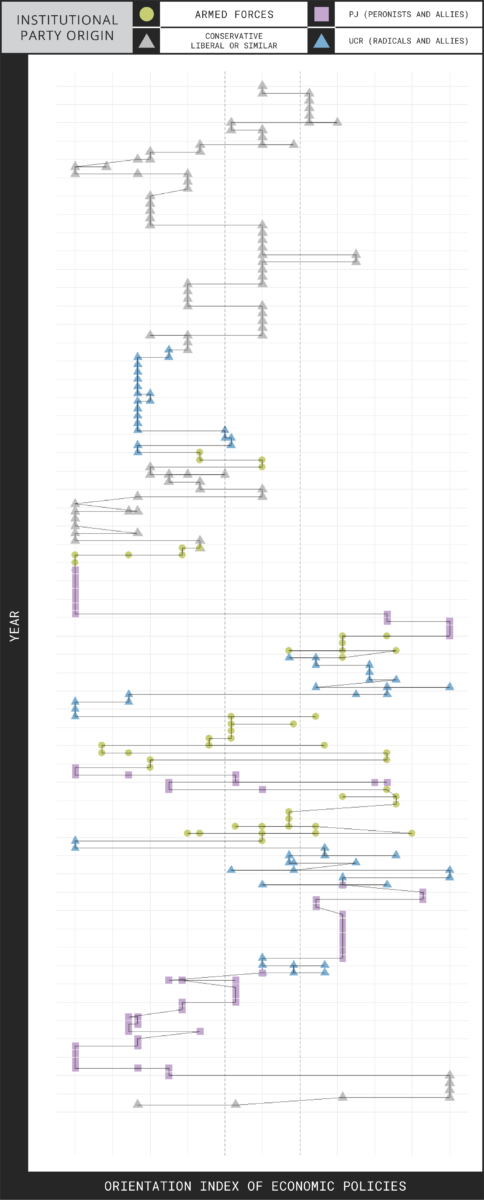
The historical analysis reveals that distributive conflict has not been a constant feature of Argentina’s macroeconomic dynamics. During the late nineteenth and early twentieth centuries, when the economy was organised around an export-led growth model, the interaction between wages and the real exchange rate was limited. Macroeconomic fluctuations existed, but they were not driven by systematic distributive tensions.
That changed with the emergence of state-led industrialisation after the 1930s. As industrial expansion increased the demand for imported inputs and capital goods, the external constraint became binding. At the same time, new social and political coalitions strengthened workers’ claims over income. From this point on, wage increases tended to generate external imbalances, while exchange-rate adjustments fed back into distributional outcomes. Distributive conflict became structural: not a temporary disturbance, but a recurrent feature of the growth process.
Economic policy played a crucial role within this dynamic. Policy responses often sought to manage distributive pressures and external imbalances in the short run, through exchange-rate management or liberalisation efforts. Yet these interventions rarely resolved the underlying tension. Instead, policy shifts frequently interacted with distributive and external forces in ways that reinforced cyclical instability.
The paper traces how this joint dynamic evolved under different development regimes. During the state-led industrialisation period, policy sometimes acted as a buffer, temporarily offsetting the exchange-rate effects of wage pressures. Over time, however, a vicious interaction emerged between policy orientation and external competitiveness, contributing to rising volatility. In the later phase of global integration from the late 1970s onwards, distributive conflict did not disappear, but it was reshaped. Lower wage rigidity and greater exposure to international markets altered adjustment patterns, with distributive tensions increasingly resolved through faster price and exchange-rate adjustments, keeping volatility high and more endogenous.
The broader implication is that economic policy matters, but not in the way it is often framed. Rather than determining long-run growth paths directly, policy exerts its influence primarily through short-run macroeconomic dynamics. By shaping how distributive tensions and external constraints are managed (or mismanaged) policy choices can amplify volatility, with lasting consequences for economic performance.
Seen from this perspective, Argentina’s experience offers a cautionary lesson. Persistent volatility is not simply the by-product of external shocks or ideological swings, but the outcome of enduring tensions between income distribution, external balance, and the policy responses used to manage them over time. Beyond its economic costs, this volatility has shaped expectations, attitudes, and collective perceptions, becoming part of how economic uncertainty is experienced and remembered. Understanding these dynamics helps explain why instability itself can become a drag on long-run growth, and why addressing volatility requires more than choosing the “right” policy stance at any given moment.
To contact the author:
Ana Laura Catelen
Universidad Carlos III de Madrid and Universidad Nacional de Mar del Plata
