Beyond Opium: Rethinking Jardine Matheson through Tea
Home > Beyond Opium: Rethinking Jardine Matheson through Tea
In this post Huirong Cheng (University of Edinburgh) presents their research, which was supported by the Economic History Society’s Research Fund for Graduate Students.
—
Tea is among the most familiar commodities in British life. For many, brewing a cup remains an ordinary domestic ritual. Yet the nineteenth-century world that brought Chinese tea to Britain was anything but ordinary. It was shaped by uneven exchange, long-distance trade, and merchant networks stretching across Asia. Within this history, few firms are better known than Jardine Matheson & Co. Founded by two Scots, William Jardine and James Matheson, the company is now remembered above all for its association with the opium trade and the imperial conflict that culminated in the First Opium War of 1839 to 1842. But what happens if we begin with tea instead?
To see why tea matters here, one must start with the structural imbalance of nineteenth-century trade between Britain and China. British demand for Chinese tea expanded dramatically across the eighteenth and early nineteenth centuries, while China remained relatively uninterested in European manufactured goods. One response to this imbalance was the expansion of the opium trade, which formed part of the background to the crisis of the late 1830s. This is why firms such as Jardine Matheson are so often placed in histories of opium, imperial conflict, and the remaking of Sino-British relations. That emphasis is well founded. Yet it can also narrow our view. It risks making tea seem like a mere prelude to a more dramatic imperial story, rather than part of the commercial structures through which that story was made.

I began to think more seriously about this tension during a recent research trip supported by the Economic History Society. At Cambridge University Library, where the Jardine Matheson Archive is held, I entered a vast paper world in which tea appeared again and again, not as a decorative side-note, but as part of the ordinary business of trade. That encounter sharpened my sense that tea was embedded in the firm’s daily operations, not merely in its historical background.
I had expected that a firm so strongly associated with opium and imperial expansion would chiefly confirm that familiar historical emphasis. Instead, I kept encountering tea in the paperwork itself: in market reports, routine correspondence, and the everyday language of commerce. Without disclosing unpublished findings in detail, I can say that the archive preserves a rich record of how tea was monitored, priced, discussed, and moved through commercial networks in South China and Hong Kong. These materials make it difficult to treat tea as merely incidental.
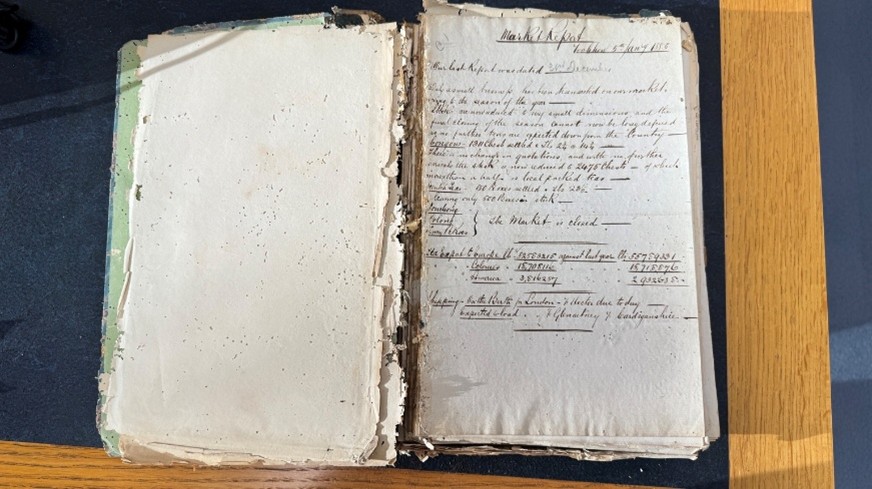
I do not mean, of course, that the existing historiography is mistaken. Scholarship has rightly stressed Jardine Matheson’s place in the histories of opium, imperial expansion, and wider transformations in Sino-British relations. Yet its place in the tea trade has generally received less sustained attention as a central subject in its own right. Looking again through tea therefore does not overturn the established picture. It rebalances it. The conflict of the late 1830s grew out of an already dense commercial world structured by commodities, information flows, trust, and mercantile decision-making. Tea was one of the key commodities in that world.
A Scottish perspective is especially useful here. In many general histories, “British trade” is treated as a broad and rather smooth category. Yet such language can obscure the regional identities, personal connections, and mercantile cultures through which trade was actually organised. Looking at the China trade through a Scottish lens helps recover actors too easily absorbed into the general label of “British merchants”. Jardine Matheson is a revealing case precisely because it was founded by two Scots and became one of the best-known firms in the China trade.
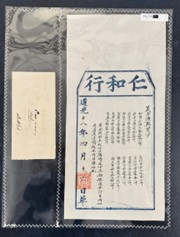
Chinese-language sources form part of this picture as well. Alongside the English-language records of foreign firms, Chinese commercial documents preserve their own paper trail of tea, credit, and exchange. Their presence is a useful reminder that this was never a story written only in English, nor only from the perspective of foreign merchants.
This is also one reason why tea matters so much as a subject of research. Tea was not simply a consumer good or a matter of domestic taste. It linked Chinese production, British demand, maritime transport, and global commerce within a single chain of exchange. It connected everyday life in Britain to labour, ecology, commerce, and political tension far beyond Britain itself. From this perspective, tea is not a minor or decorative topic. It offers one way of seeing how nineteenth-century global trade actually worked.
Looking at Jardine Matheson through tea does not displace the history of opium and empire. But it does suggest that this familiar story looks rather different when we begin instead with tea, and from a Scottish vantage point, both of which have too often remained secondary. Tea was not merely a backdrop to this history. It was one of the ordinary but powerful commodities through which that imperial world took shape.
To contact the author:
Huirong Cheng
PhD candidate in Economic and Social History, University of Edinburgh
