
Credit Generation without (External) Contract Enforcement: Property Redemption Rights in Traditional China, 1592 – 1950
Home > Credit Generation without (External) Contract Enforcement: Property Redemption Rights in Traditional China, 1592 – 1950
In this post Yunyufei Luo (University of Oxford) presents their research, which was supported by the Economic History Society’s Research Fund for Graduate Students.
—
How did people deal with credit when there is no guarantee of repayment? Debt is a theme as old as human civilisation itself, but its history before institutionalised banking is poorly understood. Scholarly efforts that go into it tend to focus on the upper tail of this market, perhaps because these predecessors to modern financial instruments supposedly fuelled the commercial and industrial expansions that gave us modern economic growth. One might argue, however, that access to credit among the ordinary people engaged with agriculture and petty commerce in is equally, if not more, important to our quest for the holy grail of sustained growth.
Under vastly different but strangely parallel contexts, peasants in more prosperous parts of Europe and Asia found themselves starting to have much more control over the land they cultivated vis-à-vis their overlords in the early modern period. After the decline of serfdom following the Black Death in Western Europe and the establishment of alienable permanent tenancies in southern China since the Ming dynasty, peasants were able to, both literally and metaphorically, reap more of what they sowed. They were given the incentive to invest in improving agricultural productivity, the necessary first step towards industrialised and urbanised economies. However, they still faced stringent constraints in the availability and costs of capital. My ongoing D.Phil. research probes into this question by examining the credit and property markets in a cluster of villages in Yongtai county, Fujian Province, in southeastern China.

Located deep in the mountains and 80 kilometres away from the county seat even on modern roads, these communities mastered the arts of self-governing that typified most of southern China in the late imperial period. In this process they developed remarkable record-keeping traditions that encompassed every façade of their daily lives from the 16th to the mid-20th century. Unlike the censuses, tax registers, or government reports which constitute the basis for a lot of economic history research, these sources were kept purely in private hands, passed down the generations in every household and guarded fastidiously as proof of their claims and rights. As a (rather inconsequential) result, I am fortunate enough to use these sources, particularly credit and property contracts, account books, and genealogies, to explore the ways they responded to the particular incentives and constraints they faced.
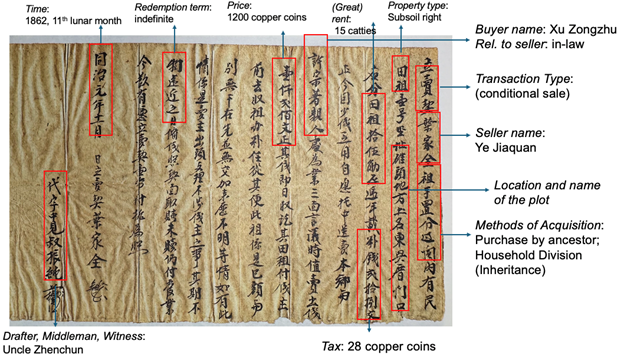
What I find is, at first sight, a handicapped conventional credit market. Straight loans and mortgages exhibited serious shortcomings. Interest rates were fixed by customary regulations: mostly 36% p.a. for cash loans and 50% in total for grain loans. In other words, people did not use variable interest rates to price different risks. Most loans were due within a year, so long-term investment was out of the question. The loan sizes were also relatively small, with the median about 100 days of unskilled labourers’ wage.
This is not hard to fathom: what self-governing could not provide, almost by definition, is impartial third-party contract enforcement. Courts did exist in late imperial China, but the lowest-level jurisdiction was reserved to the county magistrate, who had far too big a population (~260k in 1820) to serve and far too many other administrative tasks on his plate. His fiscal resources were also on a shoestring: the land tax only equalled 2.3% of the rent on a given plot in my sample on average. As a result, most cases did not get a formal hearing, and dispute resolution mostly took place within the community, where set procedures were lacking and the priority was to appease and quieten the two sides, rather than to necessarily reach a fair verdict. Not surprisingly, the account books of the actual repayment processes show that defaults, whilst not ubiquitous, were certainly severe. A median borrower paid back 92% of the principal and interest due, but those that did seriously default on their loans went so far that reduced the average repayment rate to 65%. In other words, the lenders were expected to just about recoup their principal, leaving no room for profits.
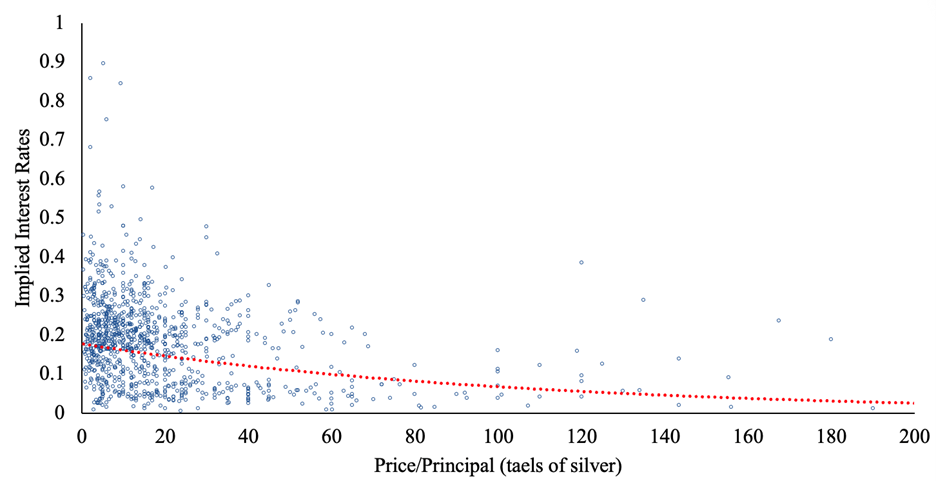
It is in this context that the ordinary people of late imperial China devised an ingenious way to circumvent this problem. They would often include a redemption clause in their real estate transactions, enabling them to buy back the property or related rights at the original price in the future. Think of it as similar to pawning — the differences being that the collateral is mostly likely an immovable rather than moveable property; and more importantly, the collateral generates interest on its own, removing the need for the borrower to pay interest directly. The yearly harvest or rent on a plot, for example, was effectively the interest. Since possession changed hands, such interest payments were largely self-enforcing, hence automatically solving the commitment problem inherent in any credit transaction. Below is a graph that plots the observations for which I can calculate the implied interest rates in these transactions. I find a negative and convex relationship between the size of the principal and the implied interest rates, as we would expect from a normal credit relationship.
I also probe into another topic that has gathered a lot of renewed interest, namely the role of social organisations in Chinese economic history. The mainstream narrative emphasises the importance of extended kinship groups in premodern China, arguing that it hindered impersonal market activities (Mokyr et. al 2025). Applying two-way fixed effect models on my sample above, however, I find that deals within the same kinship group did not correlate with lower interest rates, but deals within the same village did. In other words, Chinese people solved information problems and established trust through familiar neighbourly ties rather than distant kinship networks, just like most other premodern societies.
My future work will expand on the existing database and investigate other mechanisms through which social organisations may or may not have played a role in market activities. I would also like to find appropriate ways to compare my findings with the credit market faced by similar sections of the population in other premodern societies, including Western Europe. My goal is to ultimately revisit the familiar but unresolved question: was the cost of capital a reason why some societies got richer before others did?
The Economic History Society’s Research Fund for Graduate Students provided generous assistance to my research. The £723 grant enabled me to visit archives and libraries in Fujian Province, China to digitalise primary sources such as contracts, account books, and genealogies. I was also fortunate enough to conduct fieldworks in the villages concerned where I interviewed local residents about their past experience with property ownership, kinship organisations, and the natural landscapes. Based on this research, I also produced a poster for the recent Economic History Society Annual Conference (2026) which was shortlisted for the New Researcher Poster Prize. This was made possible by the Society’s Bursary as well. In this poster I presented the data analysis on themes discussed in this blog, and I welcome you to access it here.
Works Cited
Mokyr, J., Greif, A., and Tabellini, G., Two Paths to Prosperity: Culture and Institutions in Europe and China, 1000-2000 (Princeton, 2025).
Zheng, Z.(ed.), Fujian Minjian Qiyue Wenshu (Private Contracts and Documents in Fujian), (Fujian, 2022).
Contact the author
Yunyufei Luo
yunyufei.luo@history.ox.ac.uk
D.Phil. Candidate in Economic and Social History
University of Oxford
